

.webp)
Every startup begins with the same challenge: build something useful, validate it quickly, and avoid wasting limited time and capital.
In 2026, founders have more options than ever for building an MVP. Traditional development is no longer the only path. AI-assisted development platforms such as Replit and Lovable, alongside established no-code platforms such as Bubble, allow startups to turn ideas into working products faster than before.
But faster development creates a new question:
Which platform should you actually use to build your startup's MVP?
Should you choose Replit for its code-first approach? Is Bubble better for visual no-code development? Or does Lovable make more sense when you want AI to generate and iterate on your application?
Replit is generally a strong choice for startups that want to move quickly while retaining greater control over their code and application architecture. Bubble is well suited to visual no-code applications and business workflows, while Lovable is particularly useful for rapidly prototyping and iterating on web applications with AI assistance.
The best platform ultimately depends on what you're building, how technical your team is, and what you expect the MVP to become.
Let's break down the differences.
Replit is a browser-based development platform that allows developers and teams to write, run, collaborate on, and deploy software without setting up a traditional local development environment.
Startups can use Replit to build:
Replit is particularly interesting for startups because it combines a code-first development environment with AI-assisted development and deployment capabilities.
Instead of building an application entirely through visual components, developers can work directly with the application's code and underlying logic.
That distinction becomes important as a product becomes more complex.
An MVP may start with a simple login page, dashboard, and database. Six months later, it could require custom business logic, multiple APIs, AI features, payment processing, background jobs, analytics, and more sophisticated infrastructure.
With a code-based foundation, developers have more freedom to adapt the application as those requirements emerge.
The appeal of Replit isn't simply that it lets you write code in a browser.
The bigger advantage is reducing the friction between an idea and a working application.
Traditional development often involves several steps before meaningful product work even begins:
Set up environment → configure dependencies → create repository → configure infrastructure → build → test → deploy
Replit brings much of that workflow into a single development environment.
Its AI-assisted capabilities also change how founders and developers approach early-stage product development.
Instead of writing every feature manually from scratch, developers can use AI to accelerate tasks such as:
This doesn't eliminate the need for developers.
It changes where developers spend their time.
Instead of manually producing every line of code, developers can spend more time reviewing architecture, validating AI-generated code, solving complex problems, and making product decisions.
For an early-stage startup, the biggest advantage of Replit is the ability to iterate quickly without completely abandoning traditional development principles.
Consider a typical MVP.
You might need:
Frontend + Backend + Database + Authentication + API + Deployment
A visual no-code platform can simplify much of this.
An AI application builder can generate significant portions of it.
Replit approaches the problem through a development environment where the application can be built and modified at the code level.
This makes Replit particularly attractive when founders know that the MVP may eventually require:
The goal isn't simply to launch quickly.
It's to launch quickly without unnecessarily limiting what you can build later.
Yes, Replit offers a free Starter plan, but it comes with usage and feature limitations.
The free plan can be useful for:
However, startups building commercially important applications may need a paid plan depending on their requirements for AI usage, collaboration, development resources, and deployment.
This is an important distinction:
Free access doesn't necessarily mean free production infrastructure.
Your overall application costs can also include AI usage, deployment, databases, third-party APIs, payment processing, email services, and other infrastructure.
So when calculating the cost of a Replit MVP, don't look only at the subscription price.
Look at the total technology cost.
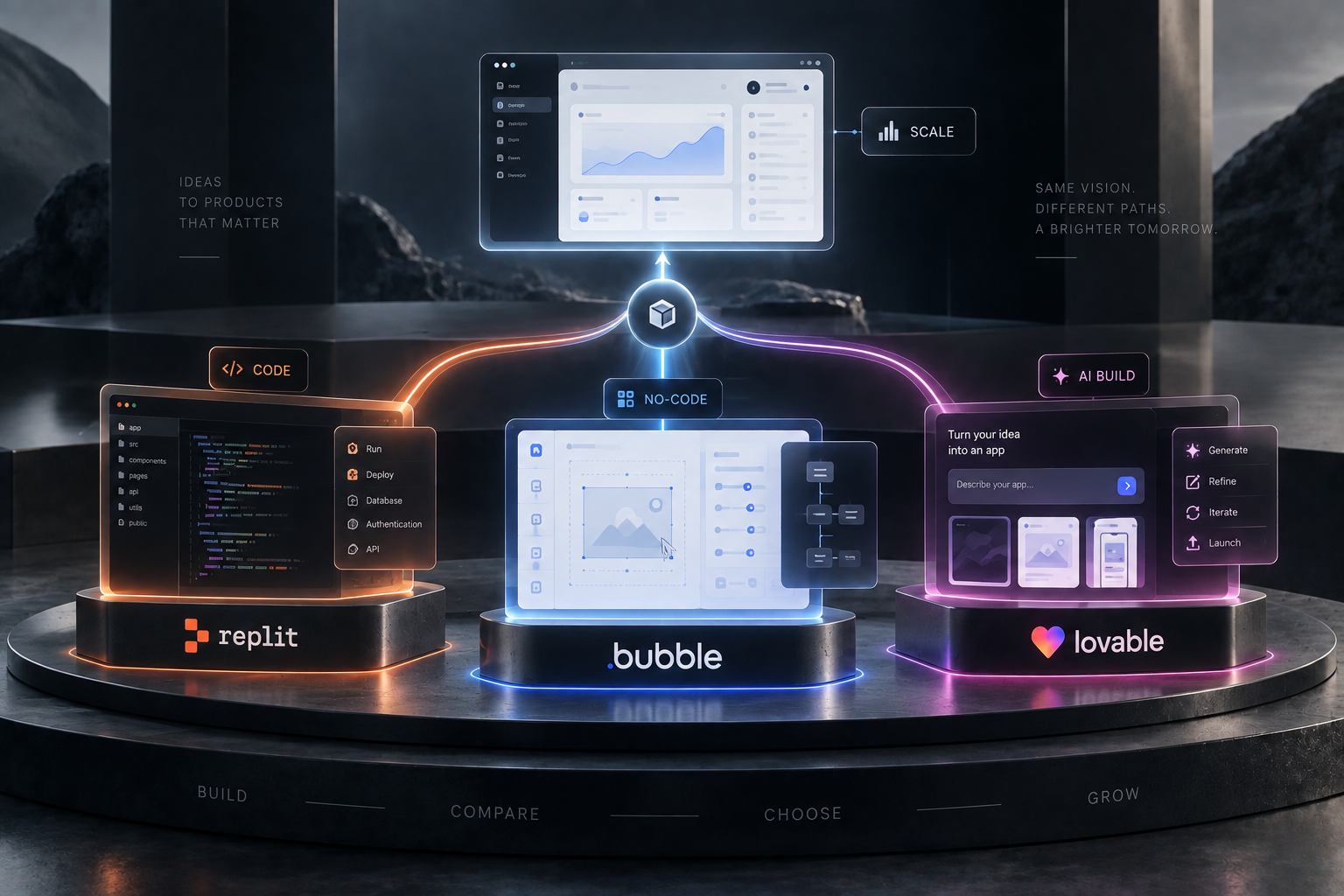
This is where the comparison becomes more interesting.
Replit, Bubble, and Lovable can all help startups build applications, but they approach development differently.
The important thing is that none of these platforms is universally better.
They optimize for different things.
Best when flexibility and code-level control matter.
Best when visual development and rapid no-code implementation are priorities.
Best when you want to describe, generate, and rapidly iterate on an application using AI.
The right decision depends on your product rather than the popularity of the platform.
Replit and Bubble are both capable of building MVPs, but they give founders different levels and types of control.
Bubble is built around visual development.
You can create interfaces, workflows, databases, and application logic without writing traditional code for every feature.
This makes Bubble particularly attractive for:
Replit takes a more code-oriented approach.
Developers can work directly with the application's source code and customize functionality at a deeper level.
This can make Replit more attractive when the product requires:
Bubble prioritizes visual development.
Replit prioritizes code-level flexibility.
Neither approach is inherently better.
It depends on what your startup needs.
Replit and Lovable are particularly interesting to compare because both are part of the broader shift toward AI-assisted software development.
Lovable allows users to describe what they want and use AI to generate and modify an application.
This can make it extremely effective for rapid prototyping.
For example:
“Build a SaaS dashboard where users can create projects, invite team members, and track progress.”
An AI-assisted platform can turn that type of instruction into a starting application much faster than a traditional development workflow.
Replit also incorporates AI into the development process, but the underlying workflow remains more closely connected to conventional code-based development.
That makes the distinction less about:
AI vs no AI
and more about:
AI-assisted application generation vs AI-assisted code development.
For simple prototypes, Lovable can be incredibly fast.
For products requiring deeper customization and development control, Replit can be a stronger foundation.
This is one of the most important questions founders should ask.
And the answer is more nuanced than simply saying “yes” or “no.”
A platform's ability to support growth depends on several factors:
A poorly designed application can struggle regardless of which platform it was built on.
Likewise, a well-designed application can support significantly more complexity than its original MVP.
That's why founders shouldn't ask:
“Can Replit scale?”
They should ask:
“Can the architecture we build on Replit support the scale and complexity our business is likely to reach?”
The same principle applies to Bubble and Lovable.
Replit is worth considering when your startup needs a combination of speed, flexibility, and code-level control.
It can be a strong fit if you want:
It is particularly attractive when you're not building a throwaway prototype.
If your MVP is expected to become the foundation of the actual product, the development approach matters more.
Bubble can be the better option when your primary goal is building a web application quickly without traditional coding.
Consider Bubble when:
For many startup ideas, Bubble can get you from concept to functional MVP extremely quickly.
The key is understanding the product's future requirements before committing to the platform.
Lovable makes sense when speed of AI-assisted prototyping and iteration is your biggest priority.
It can be particularly useful for:
It can help founders move from an idea to a working application without starting with a blank development environment.
However, once the application becomes business-critical, it should be reviewed carefully for:
Generating an application is not the same thing as engineering a production system.
That's an important distinction for every AI app builder in 2026.
Here's a practical way to think about it:
Speed + Code + Flexibility
Best for startups expecting their MVP to become a more sophisticated product.
Speed + Visual Development + No-Code
Best for teams that want to build and validate web applications without traditional development.
AI + Speed + Rapid Prototyping
Best for quickly turning product ideas into functional applications and iterating through natural-language instructions.
The biggest mistake founders make is choosing an MVP platform based entirely on how quickly the first version can be built.
That's only one variable.
You should also consider:
How quickly can you get something usable in front of customers?
How easily can you implement features that weren't part of the original plan?
What will development and infrastructure cost as usage increases?
Can the platform connect with the APIs and services your product needs?
Can the architecture support your expected growth?
How much control will you have over the underlying application?
If your requirements change dramatically, how difficult will it be to move or extend the application?
These questions matter more than simply asking which platform is currently trending.
There isn't one platform that wins every MVP comparison.
Bubble is excellent for visual no-code development.
Lovable is powerful for rapidly generating and iterating on applications with AI.
Replit stands out when startups want to combine rapid development with greater access to code and application-level flexibility.
So if you're asking:
“Which platform should I use for my startup MVP in 2026?”
Start with the product—not the tool.
If you're validating a simple concept, Bubble or Lovable may get you there faster.
If you're building something you already expect to become technically sophisticated, Replit may provide a stronger foundation for continued development.
The smartest MVP isn't necessarily the one that launches fastest.
It's the one that gets you to real users quickly without creating unnecessary problems when those users start asking for more.
Startups in 2026 need to choose based on long-term scalability, not just launch speed. Replit is built for full-code MVPs with ownership and flexibility, while Bubble and Lovable focus on rapid no-code or low-code prototyping with more constraints as products grow.
Replit is used to build, test, and deploy full-stack applications directly in the browser. Startups use it for MVPs, AI-powered tools, APIs, automation systems, and internal dashboards without needing complex setup or infrastructure management.
Replit removes traditional development friction by eliminating setup time, enabling real-time collaboration, supporting multiple programming languages, and offering instant deployment. This allows founders to build and iterate significantly faster.
Yes, Replit offers a free plan, but it is mainly suited for learning, testing, and small experiments. Most serious startups upgrade to paid plans to access private projects, better performance, and production-ready features.
Bubble or Lovable are suitable for very early-stage prototypes, simple applications, or idea validation where speed matters more than scalability. They are less ideal for complex logic or long-term product growth.
Replit is better when startups need full code ownership, custom logic, AI integrations, scalable architecture, and long-term flexibility. It is ideal for MVPs expected to evolve into production-grade products.
No-code platforms prioritize simplicity and speed but limit flexibility as complexity grows. Replit provides full-code control, allowing startups to scale, customize, and evolve their product without rebuilding later.
For serious startups aiming to scale, Replit is the strongest option because it balances speed with long-term control, avoids vendor lock-in, and supports real production-grade development from day one.


.svg)
.svg)

.webp)


.avif)
