

If you’re a founder or product builder in 2026, one truth stands out: speed matters more than ever. You can have the best idea, but if it takes months to test, you risk losing market momentum, funding opportunities, or first-mover advantage.
This is where Replit shines. It’s fast, flexible, and scalable perfect for building MVPs without the headaches of infrastructure, DevOps, or vendor lock-in.
In this guide, you’ll learn exactly how to build an MVP using Replit, step by step, with real-world examples and tips for founders.
Before coding, answer these foundational questions:
An MVP is not a “mini full product.” It’s a laser-focused version to validate your idea and gather feedback.
Pro Tip: Write a one-page brief outlining features and priorities. It will save you weeks of wasted effort.
Replit supports multiple programming languages and frameworks. Choose the one that matches your MVP needs:
Example: One AI startup built a sentiment analysis MVP entirely in Python on Replit. They launched a working demo in under 2 weeks.
Pro Tip: If you’re unsure, consider working with Replit development services for expert guidance.
Internal link: Replit development services
Focus on the one feature that solves the main problem.
Founder Tip: Resist the urge to overbuild. Early users only care about whether your MVP solves their problem.
Replit’s biggest strength is speed. With built-in live previews and collaboration:
Mini Case Study: A startup building an internal scheduling tool ran 3 iterations in a single day using Replit, compared to a week using traditional local setups.
Most MVPs need some integrations to work effectively:
Replit allows seamless API integration without server setup or deployment delays.
With Replit, deployment is straightforward:
The goal isn’t perfection it’s learning fast and improving faster.
Pro Tip: Track metrics like signups, engagement, or retention from day one to inform iterations.
Once your MVP proves the concept:
Replit supports growth because you retain full code ownership, making scaling or migration simple.
Insight: No-code tools feel fast at first but often become bottlenecks as your product grows.
Building an MVP in 2026 isn’t about stacking features or chasing perfection. It’s about proving one idea fast, learning from real users, and improving before your competitors even ship their first version.
That’s exactly where Replit changes the game.
Instead of wasting weeks on setup, servers, and DevOps, you spend your time where it actually matters: solving problems, testing assumptions, and refining your product. You write code, hit run, share a link, and get feedback the same day. That speed compounds. What normally takes months can happen in weeks, sometimes days.
Replit gives founders what most tools don’t:
• Total control over your code
• Instant deployment and collaboration
• Freedom to integrate anything
• The ability to scale without rebuilding later
No platform lock-in. No hidden ceilings. No painful migrations when your product finally takes off.
If you’re serious about validating your idea quickly and building something that can grow into a real business, not just a prototype, Replit isn’t just convenient. It’s strategic.
Start small. Ship fast. Learn constantly. Improve relentlessly.
Your MVP doesn’t need to be perfect. It just needs to exist today, not six months from now. And with Replit, there’s nothing stopping you from launching sooner than you think.
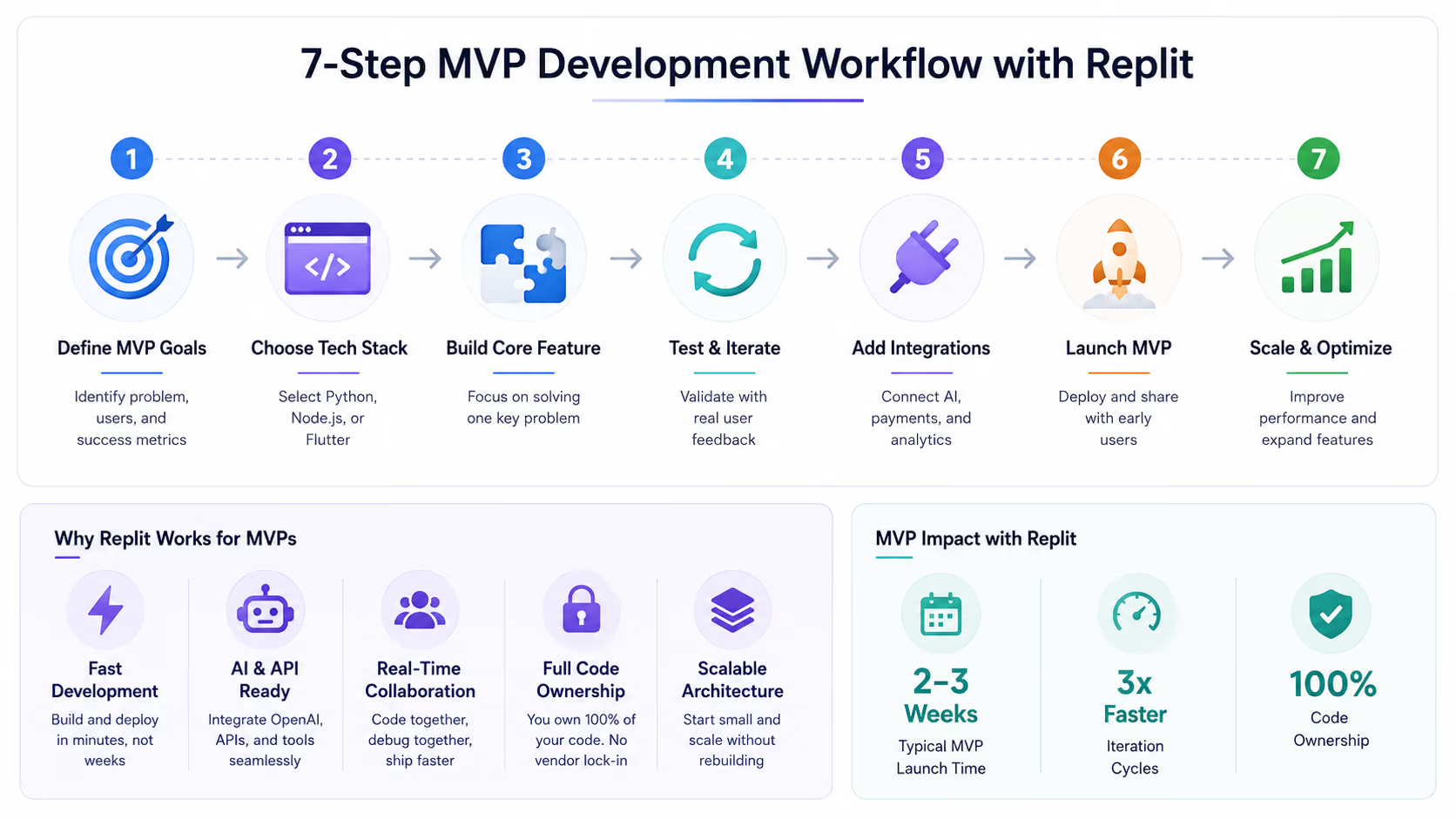
Start by identifying the core problem your product solves, your first target users, and the single most important outcome you want to validate. An MVP is not a full product, it is a focused experiment designed to test assumptions quickly with real users.
Select your environment based on your product type. Python works well for AI and backend tools, Node.js suits web apps and APIs, and Flutter or Dart is ideal for cross-platform mobile MVPs. The goal is to match simplicity with future scalability.
Always start with the core feature that directly solves the main user problem. Avoid adding extra features early. Focus on a single workflow, keep the code modular, and ensure it works before expanding functionality.
Replit enables instant execution and real-time collaboration, allowing teams to test changes immediately. This makes it possible to fix bugs, refine logic, and improve features multiple times a day based on feedback.
You can integrate APIs such as Stripe, OpenAI, Google Analytics, or custom services directly within your Replit project. No complex server setup is required, which makes it easier to test and adjust integrations quickly.
Deployment in Replit is simple and fast. You can generate a live link, share it with users, and monitor usage in real time. Version control helps track updates while allowing continuous iteration based on feedback.
Once your idea is validated, you can expand backend systems, optimize performance, and migrate to more robust infrastructure if needed. Replit supports this because you retain full code ownership and flexibility.
Keep the MVP scope small, focus only on essential features, use modular code structure, collaborate in real time, integrate APIs early, and document your work gradually to support future scaling and development.
.webp)


.svg)
.svg)
.webp)


.avif)
