

.webp)
For founders in 2026, selecting the right platform is no longer just a technical choice, it's strategic. Every tool you adopt affects how quickly you can validate ideas, iterate, scale, and attract investors.
Replit has emerged as a favorite for startups that value speed, flexibility, and code ownership. But is it really the right choice for your startup?
This guide will break down everything: step-by-step workflows, real-world examples with metrics, pitfalls to avoid, long-tail keyword insights, and comparison with no-code platforms.
Startups live and die by iteration speed and control. You could have a brilliant idea, but if it takes months to launch, competitors might beat you to market.
Founders usually consider:
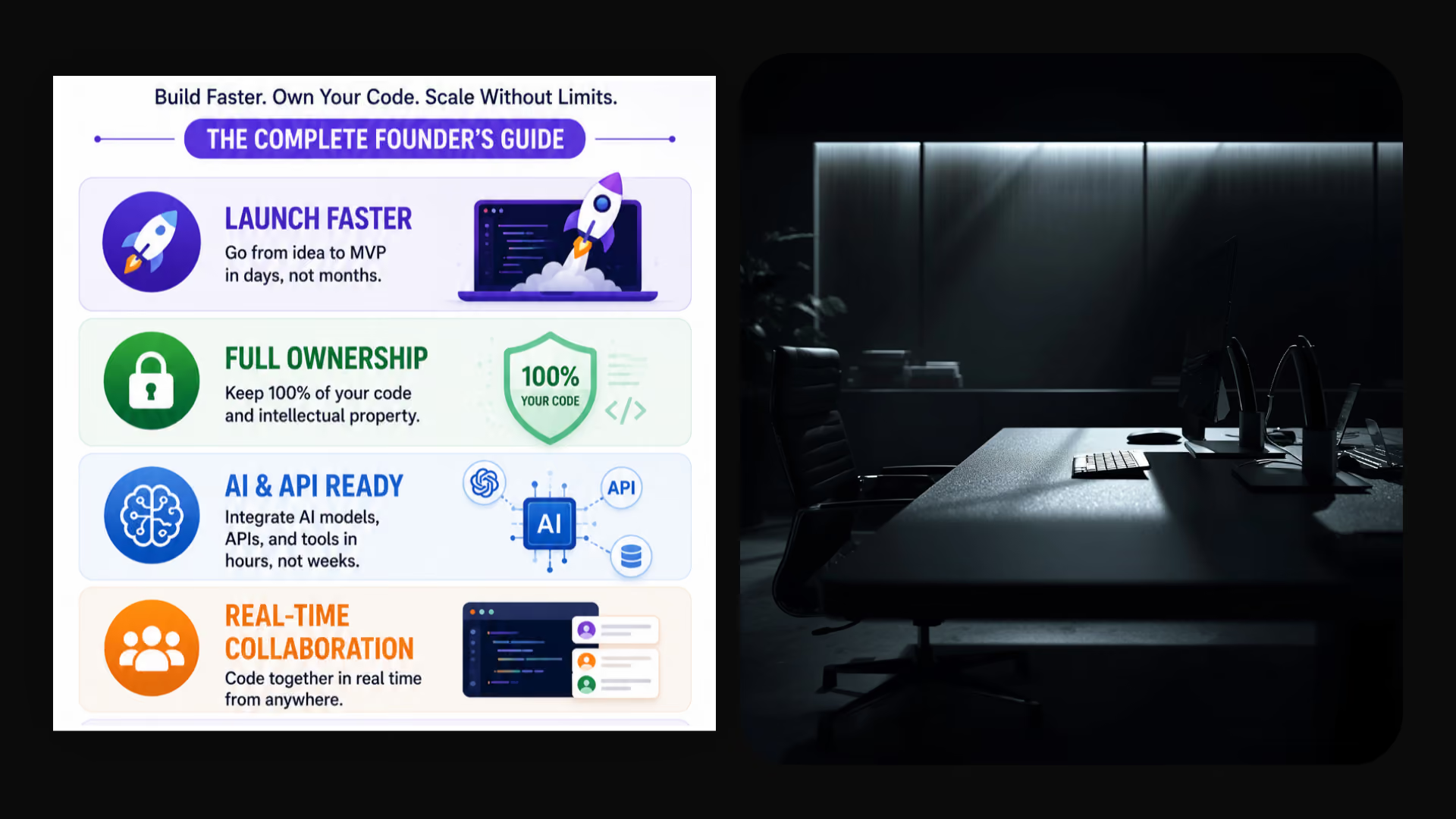
Platforms like Bubble or Lovable work for quick prototypes but often restrict flexibility and code portability, which can create bottlenecks as your product grows. Replit combines the speed of no-code tools with full-code flexibility, making it ideal for founders who plan to scale.

Before opening Replit, define your MVP’s purpose. Ask:
Founder Tip: Write a one-page brief outlining the problem, core features, and launch metrics. It keeps the team aligned and prevents scope creep.
Case Example: One AI startup used this approach to outline a sentiment analysis MVP. Within 7 days, they had a prioritized feature set and were ready to code.
Example: A logistics startup built an internal scheduling tool with Python on Replit, launched a working prototype in 2 weeks, and iterated 5 times in the first month.
Pro Tip: Consider Replit development services for expert guidance in choosing the right stack.
Start by coding the one feature that solves the main problem.
Founder Insight: Early users judge your problem-solving ability, not UI polish.
Real-World Example: A mobile AI MVP built on Flutter/Dart prioritized only the core chatbot flow. Additional features were added after user validation, reducing development time by 40%.
Replit excels in iteration speed. Teams can:
Mini Case Study: Startup X ran 3 iterations in a single day, collecting early user feedback and shipping a refined MVP in under 2 weeks. Traditional development would have taken over a month.
Pro Tip: Collect metrics like user engagement, click-through, or retention during iterations. This informs prioritization for the next sprint.
Most MVPs require integrations to be usable:
Replit makes adding these fast and simple, without complex server setups.
Example: An AI recommendation MVP integrated OpenAI APIs directly in Python on Replit, iterating features three times faster than using traditional server environments.
With Replit, deployment is built-in:
Founder Tip: Launch with metrics tracking in place. Monitor KPIs like signups, retention, and engagement from day one.
Once your MVP validates the concept, plan for:
Replit supports growth because you retain full code ownership, making migration or scaling smooth.
Case Study: Startup Y migrated their Replit MVP to a fully scalable cloud backend without rewriting major code sections, thanks to modular coding.
Founder Hack: Allocate 1–2 hours per week to document architecture, dependencies, and workflows.
Insight: Bubble/Lovable work for fast validation, but Replit allows startups to scale without platform constraints.
Tip: Use feature flags to test new functionality without affecting production users.
These examples show Replit’s real-world scalability and speed.
In 2026, building an MVP isn’t just about speed. Founders need control, flexibility, and scalability to turn early ideas into successful, sustainable products. Replit provides all of this in a single, browser-based platform, empowering startups to move faster and smarter than ever before.
With Replit, founders can:
For startups that want to move fast, iterate smarter, and scale without compromise, Replit is more than a coding tool it’s a strategic launchpad. It allows founders to focus on what truly matters: validating ideas, delighting users, and building products that can grow into impactful, scalable solutions in 2026 and beyond.
Yes, Replit is one of the strongest platforms for startups in 2026 because it combines fast MVP development, real-time collaboration, full code ownership, and scalable architecture in a single browser-based environment.
Startups choose Replit because it offers the speed of no-code tools while giving full access to real code. This allows founders to build quickly, customize deeply, and scale without platform restrictions or vendor lock-in.
Replit eliminates local setup, supports multiple programming languages, enables instant deployment, and allows fast iteration directly in the browser. This helps startups validate ideas faster and improve products based on real user feedback.
Yes, Replit supports seamless integration with AI APIs like OpenAI and Hugging Face, along with payment gateways, analytics tools, and custom automation systems. This makes it ideal for AI-first MVPs and API-driven products.
Startups can typically launch a working MVP within one to three weeks depending on project complexity. Replit’s instant coding environment and built-in deployment significantly reduce traditional development delays.
Yes, Replit supports modular development and full code ownership, allowing products to scale naturally. Startups can optimize infrastructure, expand backend systems, and migrate if needed without rebuilding their product.
Founders should avoid overbuilding features too early, skipping version control, delaying API planning, relying only on free-tier resources for production, and failing to document architecture for future scaling.
Absolutely. Replit gives founders speed, flexibility, and technical control while avoiding the limitations of no-code tools. It allows startups to validate ideas quickly and grow confidently into production-ready businesses.
.webp)


.svg)
.svg)



.avif)
