

%20(1).avif)
Building an MVP is not just about getting an application into users' hands quickly. For startups, development costs, AI usage, hosting, infrastructure, and future scalability can all affect how long your runway lasts.
Replit has become an increasingly popular platform for building MVPs, SaaS applications, AI-powered products, internal tools, and web applications. But understanding how Replit pricing works in 2026 is important before choosing a plan or deploying a product.
So, how much does Replit cost for a startup?
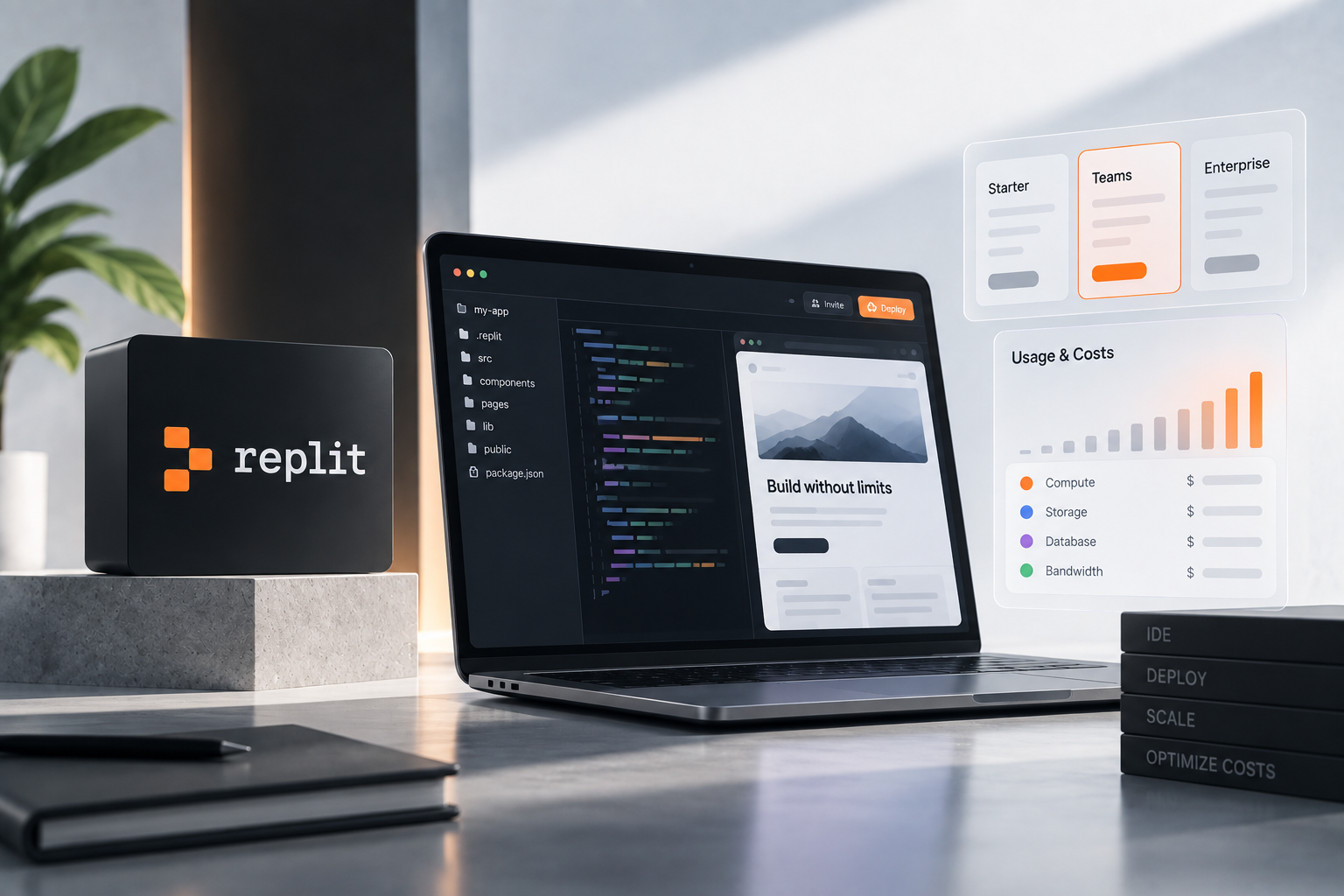
Replit currently offers Starter, Core, Pro, and Enterprise plans. The Starter plan is free, Core starts at $20 per month ($17/month when billed annually), Pro starts at $100 per month ($95/month annually), and Enterprise uses custom pricing. Replit also uses credits and usage-based billing for certain features and workloads, meaning your total cost can depend on how you use the platform rather than simply which subscription you select.
This guide explains Replit pricing, hosting, deployment costs, AI usage, and practical ways startups can keep their Replit development costs under control.
Here is the current high-level structure:
Replit PlanStarting PriceBest ForStarterFreeExploring Replit and early prototypesCore$20/month or $17/month annuallyPersonal projects and simple appsPro$100/month or $95/month annuallyCommercial and professional applicationsEnterpriseCustomLarger organizations requiring advanced security and controls
Replit's pricing page currently lists these four plans. Core includes additional Agent usage and monthly credits, while Pro increases the available credits, collaboration capacity, Agent capabilities, and support options.
Important: These subscription prices should not be treated as your complete application budget. AI usage, deployment, compute, storage, and other usage-based resources can affect the final cost.
There is no single Replit price for an MVP because the total cost depends on what you build and how you use the platform.
A simple prototype might require very little paid infrastructure.
A production SaaS application with:
can have considerably different costs.
For most startups, it is more useful to think about Replit costs in four categories:
This is the base plan you pay for access to Replit's development environment and included capabilities.
AI-assisted development can consume credits depending on the models and workloads being used.
Once your application is live, deployment resources and traffic can contribute to your costs.
Your Replit application may also depend on services such as:
These costs are separate from your Replit subscription.
This distinction is critical when calculating the real cost of a Replit MVP.
The Starter plan is Replit's free tier and is designed for exploring the platform and building initial projects.
According to Replit, Starter includes free daily usage, a built-in database, the ability to publish one live project, and one background task at a time.
It can make sense for:
However, startups building a commercial MVP will often need capabilities beyond what the free tier provides.
Replit Core starts at $20 per month, or $17 per month when billed annually. It is positioned by Replit for personal projects and simpler applications.
Core includes additional Agent usage, monthly credits, Plan mode, unlimited workspaces, and the ability to invite collaborators. Replit's current information also lists AI integrations as part of the plan.
For an early-stage founder, Core can be a reasonable starting point when:
The important point is that the $20 subscription should not automatically be considered the total cost of running the application.
Replit Pro starts at $100 per month, or $95 per month when billed annually. Replit positions Pro for commercial and professional builds.
Pro provides significantly more resources for teams building serious applications, including higher Agent usage, $100 in monthly credits, up to 15 collaborators, up to 50 viewers, premium support, and additional database rollback capabilities.
For startups, Pro becomes more relevant when:
Replit introduced Pro in February 2026 and sunset its previous Teams plan as part of the pricing restructuring.
Replit Enterprise is designed for organizations that need additional security, privacy, administration, and infrastructure controls.
The current Enterprise offering includes features such as:
Pricing is customized based on the organization's requirements.
For most early-stage startups, Enterprise is unnecessary during MVP validation.
The more sensible approach is usually to start with the smallest plan that supports the product and upgrade when actual requirements justify it.
Replit is not simply a code editor.
Its deployment platform allows applications to move from development to production without requiring founders to configure an entirely separate hosting environment.
Replit currently provides multiple deployment options, including:
Autoscale is designed to dynamically adjust resources based on demand, while Reserved VMs provide dedicated resources for applications that require more consistent performance. Static Deployments are intended for websites and client-side applications.
This makes Replit attractive for startups because development and deployment can remain within the same ecosystem.
But hosting costs still need to be considered separately from your subscription.
It can.
Your Replit subscription and your application's production infrastructure are not necessarily the same expense.
The final hosting cost can depend on factors such as:
Replit has historically supported usage-based billing for resources beyond plan allowances, giving users a way to pay for additional consumption rather than moving immediately to a higher subscription tier.
That's why startup founders should look at total usage, rather than assuming that the subscription price represents the complete monthly infrastructure bill.
There is no universal hosting price for a Replit application.
A small application with limited traffic can have very different infrastructure requirements from an AI application processing thousands of requests.
Replit's deployment options are designed around different workloads. Autoscale deployments can scale resources according to demand, while Reserved VMs are designed for applications that need dedicated resources and more consistent performance.
For this reason, founders should estimate hosting costs using:
Expected users × application activity × compute requirements × data transfer
rather than simply asking:
“How much does Replit hosting cost?”
The answer depends on what your application actually does.
This is one of the most important cost considerations for startups using Replit in 2026.
Replit has incorporated AI-assisted development directly into its platform, and its current plans include different levels of Agent usage and monthly credits.
This means founders should consider AI usage when creating their development budget.
For example, repeated Agent requests can become more expensive when developers are:
The goal should not be to avoid AI usage.
Instead, the goal should be to use AI where it produces meaningful development value.
The best way to control Replit costs is not necessarily to choose the cheapest plan.
It is to control what you build, how you build it, and what resources you consume.
Here are some practical strategies.
Don't purchase enterprise-level resources before your product has demonstrated demand.
Start with the plan that supports your current development requirements and upgrade when your application actually needs more capacity.
One of the biggest startup cost problems is uncontrolled scope.
A founder starts with:
“We just need a simple MVP.”
Then the project becomes:
before the first user ever sees the product.
A smaller MVP is not just faster.
It is cheaper to develop, test, deploy, and maintain.
AI-assisted development can dramatically accelerate development, but inefficient prompting can create unnecessary usage.
Instead of repeatedly asking an Agent to rebuild an entire feature, break complex work into smaller, well-defined tasks.
For example:
Bad approach:
Rebuild the entire dashboard and fix everything.
Better approach:
Fix the authentication workflow without modifying the existing database structure.
Clearer instructions can reduce unnecessary iterations and make development easier to control.
This is one of the most overlooked ways to reduce MVP costs.
Poor architecture creates rework.
If authentication, database structure, API integrations, and application workflows are designed poorly, developers may spend significantly more time fixing the foundation later.
A few hours spent defining the architecture can save much more time during implementation.
Don't treat your production environment as your experimentation environment.
Use development and production workflows appropriately so that testing, debugging, and experimentation do not unnecessarily affect the live application.
This becomes increasingly important as the application gains real users.
If your application uses AI, analyze how often models are called and what each request is doing.
You may be able to reduce costs by:
The cheapest AI architecture is usually not the one with the cheapest model.
It is the one that doesn't make unnecessary calls.
The biggest mistake is treating the subscription price as the entire technology budget.
A startup might think:
“Replit costs $20 per month, so our application costs $20 per month.”
That's rarely a useful way to budget.
Your actual technology costs may include:
Replit subscription
AI/Agent usage
Deployment/compute
Database
External APIs
Email/SMS
Payments
Monitoring
Third-party services
This is your application's technology operating cost.
Understanding that number before launch gives founders much better visibility into their runway.
Imagine a startup building a SaaS MVP with:
The founder shouldn't simply budget for a Replit subscription.
Instead, create a cost model like:
Cost CategoryWhat to EstimateReplit planSubscriptionAI developmentAgent/AI usageHostingCompute + deploymentDatabaseStorage + usageAI APIsModel/API consumptionPaymentsTransaction feesEmailTransactional emailMonitoringApplication monitoringOther APIsThird-party services
This approach produces a much more realistic MVP budget.
A simple decision framework is:
You are exploring Replit, learning the platform, or building a very early prototype.
You are an individual founder or small team building a relatively simple application and want additional Agent usage and development capabilities.
You are building a commercial product, need more AI development capacity, require larger collaboration capabilities, or are moving toward production.
Your organization requires advanced security, privacy, identity management, dedicated environments, or enterprise-level administrative controls.
These recommendations align with how Replit currently positions its plans.
It can be, particularly for startups that value fast development and want to keep development and deployment within one platform.
Replit reduces some of the infrastructure complexity traditionally associated with getting an application from development into production. Its deployment platform handles hosting and scaling options directly within the Replit ecosystem.
But cost-effectiveness depends on the application.
A poorly architected application can become expensive regardless of the platform.
The real objective should therefore be:
Build the smallest useful product, use infrastructure appropriate to current demand, and scale resources as usage grows.
One reason startups consider Replit is that it can reduce the infrastructure and development friction associated with building an MVP.
Traditional development may require separate tools for:
Replit brings many of these workflows into a single platform.
That does not mean Replit eliminates development costs.
Instead, it can reduce the operational complexity involved in getting from idea to deployed product.
For startups, that can have significant value.
Don't upgrade simply because your application is growing.
Upgrade when your requirements are growing.
Consider moving to a higher plan when:
Likewise, don't keep paying for unused capacity simply because you expect growth.
Pay for today's requirements while architecting for tomorrow's.
Choosing a Replit plan is only one part of managing MVP costs.
The larger question is:
How should the application be structured so that development remains efficient as the product grows?
At InceptMVP, we help startups approach Replit development with that bigger picture in mind.
Our support can include:
The goal isn't simply to build an MVP quickly.
It's to build an MVP without creating unnecessary technical debt or infrastructure costs.
There isn't a single Replit cost that applies to every startup.
In 2026, Replit's subscription plans range from free Starter access to Core, Pro, and custom Enterprise pricing, while application costs can also depend on AI usage, deployment resources, compute, storage, and external services.
For most founders, the smarter approach is:
Start small.
Define the MVP clearly.
Monitor usage.
Control AI consumption.
Choose the right deployment architecture.
Scale infrastructure when real demand justifies it.
Your goal isn't to build the cheapest possible application.
It's to build an application that gives you the highest amount of product validation for every dollar you spend.
And that's ultimately what good startup cost management looks like.
Replit offers multiple pricing tiers for startups in 2026, including a free plan for testing, the Hacker plan for private MVP development, Teams Pro for collaboration-heavy startup projects, and enterprise-level custom plans for larger-scale deployments.
The Hacker plan is ideal for solo founders or early-stage MVP testing, while Teams Pro works best for startup teams that need private deployments, faster compute resources, and collaborative workflows.
Replit’s free tier is useful for learning and basic prototypes, but serious MVP development usually requires paid plans because private projects, advanced compute power, and production hosting are limited on free accounts.
Hosting costs depend on your selected plan, app traffic, compute usage, storage requirements, and deployment frequency. Most startups begin with low monthly costs and scale spending as user demand increases.
Startups can reduce costs by choosing smaller plans initially, using modular code architecture, optimizing compute-heavy AI processes, monitoring resource usage regularly, and scaling only when product traction justifies it.
Yes, Replit is often more cost-effective for MVP development because it removes setup complexity, combines development and hosting in one platform, and reduces the engineering time required to launch products.
Replit allows gradual scaling, which helps founders increase resources as user growth happens instead of committing to expensive infrastructure upfront. This keeps costs predictable during early-stage growth.
Startups partner with agencies like InceptMVP because experienced teams help choose the right Replit plan, optimize hosting costs, avoid unnecessary infrastructure spending, and build scalable MVPs that stay on budget and launch faster.
.webp)


.svg)
.svg)
.webp)


.avif)
