
We are Official Certified bubble.io & flutterflow App Development partner


.png)
.png)
Most founders treat this like a branding decision.
Pick a lane, design the website accordingly, and move on. B2B gets the corporate blues and a LinkedIn presence. B2C gets the friendly colors and a TikTok account.
But the choice between B2B and B2C is not aesthetic. It quietly shapes how you build the product, how you sell it, how fast you can validate it, what kind of investors find it interesting, and how your entire growth strategy needs to work.
Get it right and you are solving the right problem for the right audience from day one. Get it wrong and you spend the first year discovering that everything, the messaging, the pricing, the sales process, the product itself, is pointing in the wrong direction.
This is how to think through it clearly.
The textbook definition is simple enough. B2B means you sell to other businesses. B2C means you sell directly to individual consumers.
But the real difference is not who the customer is. It is how they make decisions, how long the sales cycle runs, what makes them stay, and what makes them leave.
In a B2B context, you are selling to someone who is trying to solve a business problem. They are thinking about ROI, implementation, team adoption, security, and whether their manager will approve the purchase. Decisions move slowly. Multiple people are involved. The criteria are mostly rational.
In a B2C context, you are selling to an individual who is trying to solve a personal problem or satisfy a personal desire. Decisions happen fast, sometimes in seconds. Emotion drives a significant part of it. The bar for switching to a competitor is low because the switching cost is usually nothing.
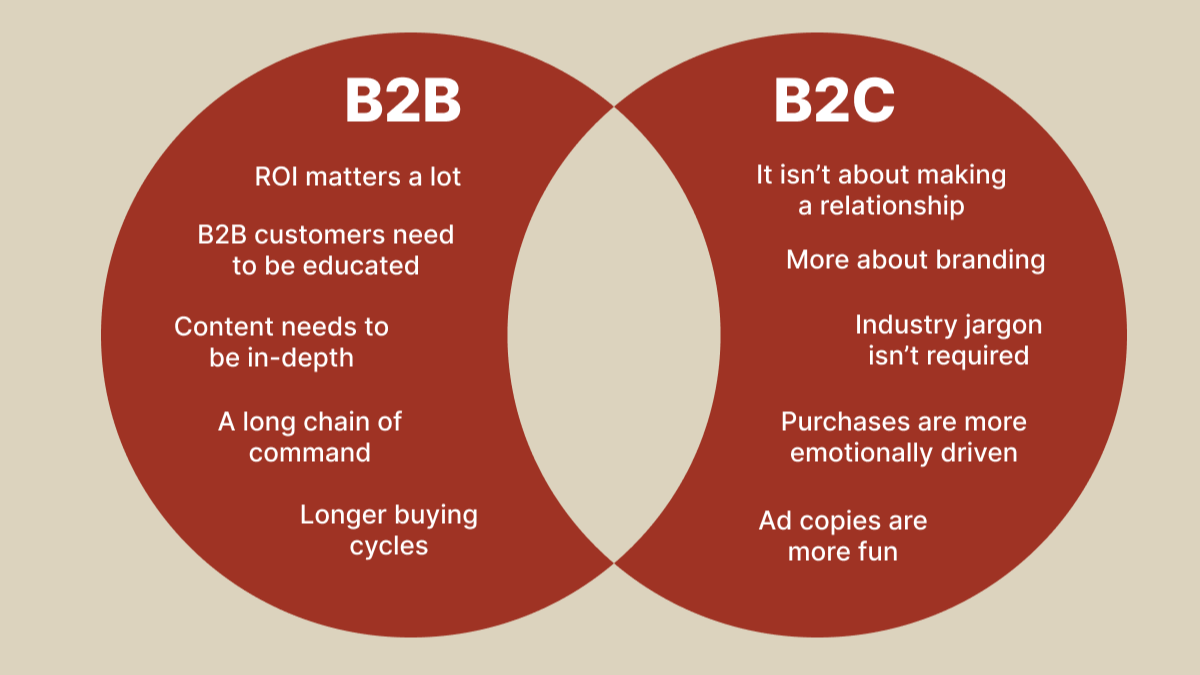
Neither is harder than the other in an absolute sense. They are just different games. And knowing which game you are playing changes almost everything about how you approach building and growing the product.
B2B startups tend to start slower. The sales cycle is longer. You might spend three months closing a single client that a B2C app would have converted in thirty seconds.
But there is a trade-off that makes this worth it for the right founder in the right situation.
When a business signs up and integrates your product into their workflow, they do not leave easily. The switching cost is real. The retention is stronger. The revenue per customer is significantly higher. And the feedback you get is more structured and more actionable because your customers are professionals with specific, articulable needs.
B2B also tends to be easier to validate early. You can have direct conversations with potential customers before you build anything. You can charge from the beginning rather than spending months building an audience and then trying to monetize it. Ten paying business customers tells you more about product-market fit than a thousand free consumer signups.
The founder who does well in B2B usually understands a specific industry from the inside. They know the pain well enough to speak to it credibly. They have the patience for longer sales cycles and the communication skills to navigate multi-stakeholder decisions.
If you already understand the audience and want to move from idea to execution, the next step is learning how to turn that concept into a working product here: How to Turn a Startup Idea Into a Real Product.
B2C moves faster in the early stages. You can launch something, put it in front of users, and get real behavioral data within days. The feedback loop is quick. Iteration is faster. And if something works, it can spread quickly through word of mouth and social sharing in a way that B2B products almost never do.
The scale potential is also genuinely larger. A B2B product serving mid-sized companies might realistically have tens of thousands of customers if everything goes well. A B2C product with strong product-market fit can reach millions.
But the challenge is that consumer retention is genuinely hard. People download apps and forget about them. They sign up and never come back. They switch to competitors for reasons that have nothing to do with your product quality. The market is noisier, the competition is more intense, and the cost of acquiring and keeping users can be significant.
Monetization in B2C also takes longer to figure out. Freemium models require volume before they generate meaningful revenue. Subscription models require strong enough value for users to justify a recurring payment. Advertising models require traffic numbers that take time to build.
The founder who does well in B2C is usually someone with a strong instinct for consumer behavior, genuine patience for the testing and iteration cycle, and either a compelling growth channel or the budget to experiment with acquisition until one works.
If your product solves a problem that a large number of individuals face daily and you can create genuine habit around using it, B2C is worth pursuing. Once you have a B2C product with real habit potential, the next challenge is getting early traction, which is covered here: How to Get Your First 1000 Users After Launch.
Forget the frameworks for a moment. Three questions tend to cut through most of the confusion.
Who feels this problem more urgently? A business losing money or time every week because of a process problem has urgent, measurable pain. An individual who is mildly inconvenienced has a different kind of need. Urgency determines how hard the sale is and how quickly you can validate.
Who is more likely to pay early? Businesses are generally more willing to pay for solutions to real operational problems than consumers are to pay for new apps. If early revenue matters to your runway, this question matters a lot.
Who can you actually reach right now? If you have spent years in a specific industry and know fifty potential B2B customers personally, that network is an asset. If you have a large following in a consumer niche, that is an asset too. Your existing access to customers is an underrated factor in this decision.
The honest answers to those three questions will point you in a clearer direction than most articles on this topic.
Every few months a founder comes in with a product that is simultaneously trying to serve businesses and individual consumers, with a pricing model that does not quite work for either and a message that resonates with neither.
It sounds like ambition. It is actually a failure to commit.
B2B and B2C require different product decisions, different sales approaches, different marketing strategies, and different success metrics. Trying to optimize for both at the same time means you are never fully optimizing for either.
Many successful companies have evolved from one model to the other. Slack started as a tool for internal team communication, which is firmly B2B, and grew from there. Several B2C marketplaces eventually developed B2B offerings once they had the scale and the data to make it worthwhile.
But they did not start by trying to serve everyone. They picked one audience, solved the problem deeply for that audience, and expanded from a position of strength rather than trying to hedge from the beginning.
Pick one. Validate it properly. Then consider expanding.
Broader industry research on startup outcomes consistently shows how critical early validation is before choosing a direction, and this data-backed overview highlights those patterns clearly: https://www.meegle.com/en_us/topics/entrepreneurship/b2b-vs-b2c-startup-strategies
The founders who struggle most with this decision are usually not confused about B2B versus B2C in theory. They are avoiding a more uncomfortable question, which is whether their idea has a specific enough audience to validate at all.
"It could work for businesses and consumers" is often a way of saying "I am not sure who actually needs this badly enough to pay for it."
The pattern that works consistently is narrowing down before opening up. Pick the most specific possible version of your target user. Solve the problem for that person or that company in a way that is genuinely better than what they are doing today. Validate that it works. Then broaden.

Whether that narrow starting point is a B2B niche or a B2C community does not matter as much as the specificity itself. Focused validation beats broad guessing every time, regardless of the model.
The honest answer is that investors do not uniformly prefer one over the other. What they prefer is traction and a credible story about how it scales.
That said, B2B tends to be easier to make a financial case for early on because the revenue is cleaner. Contracts, recurring payments, and measurable retention are things investors can underwrite with more confidence than consumer engagement metrics that have not yet converted to revenue.
B2C can attract significant investment when the growth metrics are strong and the retention is genuinely good. But the bar is higher because the risk of churn and the difficulty of monetization are well understood by anyone who has backed consumer products before.
If you are planning to raise funding, understanding what your model looks like from an investor's perspective is worth factoring into the decision.
For a deeper breakdown of how B2B and B2C models operate in real startup environments, this guide offers a clear comparison worth exploring: https://www.startupsuperschool.com/articles/b2b-vs-b2c-startup
B2B gives you depth. Fewer customers, higher value, stronger retention, clearer ROI conversations.
B2C gives you scale. Larger audience, faster feedback loops, stronger viral potential, harder monetization.
Neither is the right answer for every founder or every idea. The right answer is the one that matches the specific problem you are solving, the audience that feels it most urgently, and the skills and network you are bringing to the table.
The best founders do not choose B2B or B2C because one sounds more impressive or because they read that one model is outperforming the other right now. They choose based on where they have the highest chance of genuine validation in the shortest amount of time.
Make that choice with clarity and then commit to it fully. Everything else gets easier when the direction is clear.
If you are at the stage of figuring out what to build and for whom, that is exactly the kind of conversation InceptMVP is built for. Work With Us
Neither is universally better. B2B is generally easier to monetize early and simpler to validate through direct customer conversations. B2C offers larger scale potential but requires more patience with monetization and retention. The better question is which model fits your specific problem, audience, and current strengths.
Yes, and it happens more often than most people realize. Several well-known products started with consumer adoption and then developed business-facing products once they had the user base and data to justify it. The key is not trying to do both simultaneously in the early stages.
B2B tends to be easier to validate quickly because you can have direct, structured conversations with potential customers before building anything. A business that would pay for a solution to a real operational problem is a clearer signal than consumer interest, which is harder to translate into actual willingness to pay.
Investors evaluate traction and scalability more than model type. B2B tends to produce cleaner early revenue metrics which can be easier to underwrite at the early stages. B2C can attract significant investment when growth and retention metrics are strong. Both models have produced major investment returns.
Trying to serve both at once without the resources or focus to do either well. The second most common mistake is choosing based on trends rather than on where the problem is most acute and where the founder has the most genuine advantage. Both mistakes delay real validation and waste early runway.


.svg)
.svg)
.png)
.png)


.avif)
