

.avif)
Lovable builds you a beautiful, functional web app in days. But when your users ask "can I download this from the App Store?" that's where most founders hit a wall.
This is the story of how we solved that problem without throwing away a single line of code.
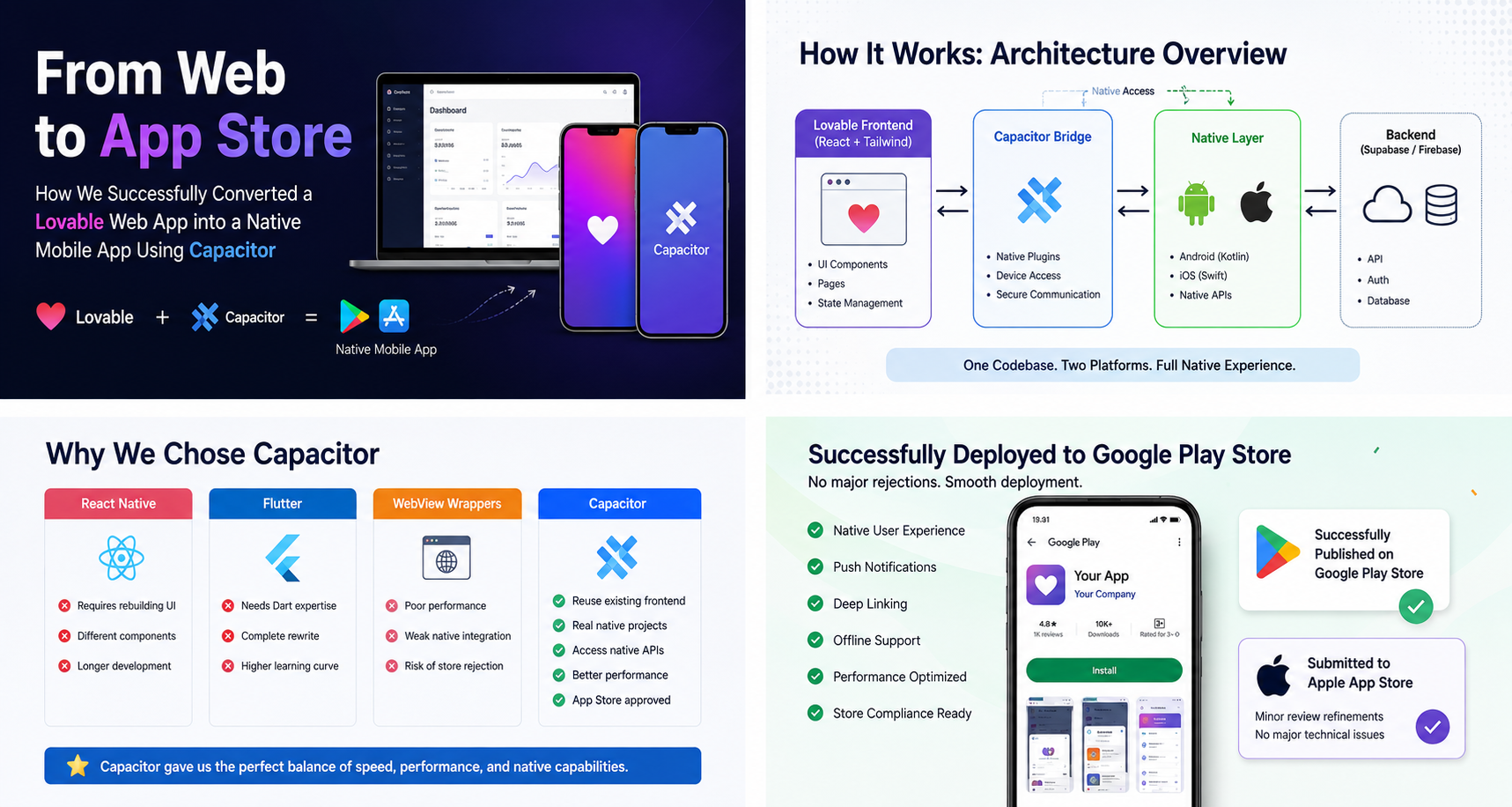
Lovable uses React, Vite, and Tailwind CSS to generate production-grade web applications fast. That's genuinely powerful — but it has one blind spot. When most people say they want an "app," they mean a home screen icon, a Play Store listing, push notifications, and a native feel. Not a browser tab.
The gap between "web app" and "mobile app" isn't technical complexity. It's user expectation. And if you don't close it, you leave retention and trust on the table.
Yes. And you shouldn't have to rebuild.
We used Capacitor to wrap the existing Lovable frontend inside real native Android and iOS shells preserving every component, route, and API integration while gaining access to device-native functionality:
No rewrite. No new tech stack. Same codebase, real native apps.
This was a deliberate choice, not a default.
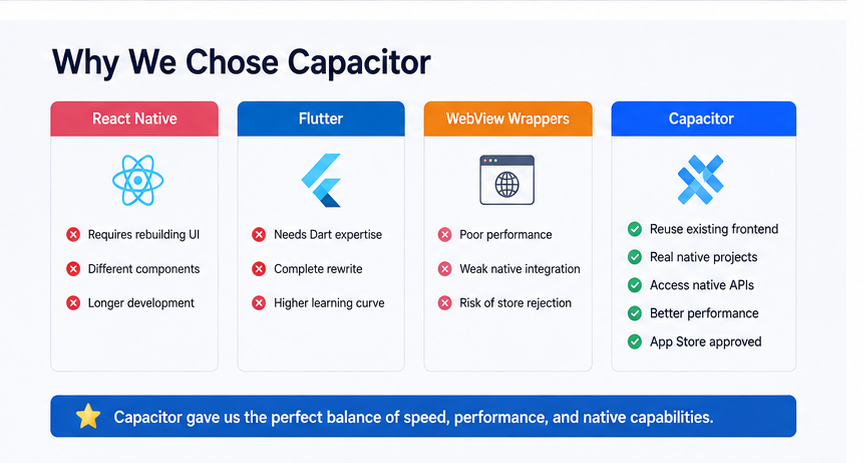
React Native requires rebuilding the entire interface using RN-specific components. Since Lovable generates standard HTML/CSS/React, that means scrapping the frontend entirely.
Flutter uses Dart, a complete language switch. Again, full rebuild.
Basic WebView wrappers are the worst of all options. Apple routinely rejects apps that feel like a dressed-up website, and they're right to. Poor performance, clunky navigation, and weak native integration make them a non-starter.
Capacitor threads the needle. It turns your existing web frontend into a real native project complete Android Studio and Xcode codebases while bridging JavaScript calls to native APIs where needed. You get web development speed and native app output.
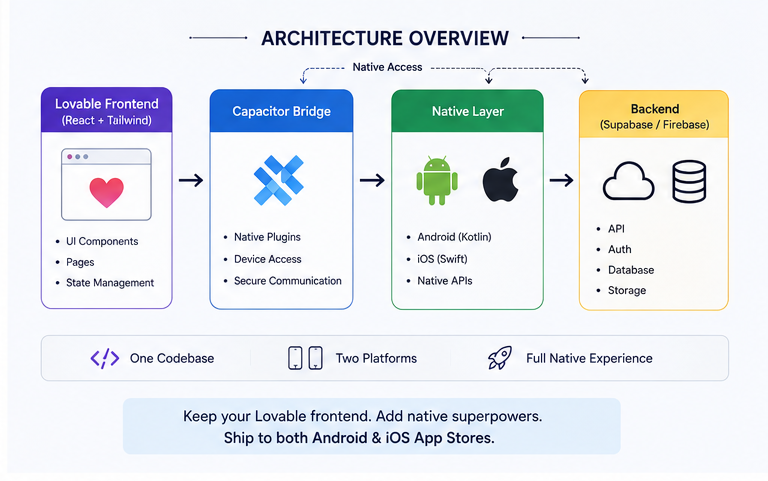
The architecture stayed clean. The Lovable frontend remained the UI layer. The backend (Supabase/Firebase, auth, APIs) stayed completely untouched. Capacitor generated the native shells around it.
The engineering work and there was real engineering work went into mobile-specific edge cases:
Mobile UX polish. Responsive isn't the same as native. We handled iPhone notches, Android nav bars, safe area insets, keyboard behavior, and removed browser-like artifacts (tap delays, text-highlight flicker, unintended zoom).
Authentication persistence. Mobile users expect to stay logged in. We implemented secure token storage using Capacitor plugins so sessions survive restarts, updates, and OS memory management.
Native permissions. Camera, notifications, location, all require proper permission flows on both platforms. We integrated the right Capacitor plugins and made sure they met Apple and Google's privacy requirements.
Push notifications. Web push doesn't work reliably in native containers. We wired Firebase Cloud Messaging through Capacitor's push plugin for consistent delivery on both platforms.
Deep linking. Password resets, shared links, invite URLs all configured to open directly inside the app rather than bouncing users to a mobile browser.
Performance. Bundle optimization, lazy loading, CSS animation tuning, and React render improvements brought startup speed and scroll performance up to native-quality standards.
The Android app passed Google Play review without any significant rejection or compliance issue. That's not a given for web-to-app conversions stores actively screen for apps that feel like website wrappers. We avoided that outcome by building actual native integrations, not just wrapping a URL.
For iOS, Apple's review process was stricter, as expected. We encountered minor feedback on UI polish and metadata nothing architectural. No rebuild required.
Compared to building separate native Android and iOS apps from scratch:
Use Lovable + Capacitor if:
Skip it if:
For the vast majority of startup products, Capacitor delivers the right balance between speed, cost, and native quality.
InceptMVP handles the full conversion: Play Store and App Store deployment, push notifications, deep linking, mobile optimization, and production-ready native performance. [Get in touch.]
Not if it's built correctly. Apps that are essentially just WebViews get rejected, but Capacitor apps with genuine native integrations, optimized UX, and proper permissions handling pass review. Ours did.
Timelines vary with complexity, but this approach is significantly faster than native rebuilds. Weeks, not months, is realistic for a production-ready conversion.
Yes. Both are handled through official Capacitor plugins, with Firebase Cloud Messaging for push and App Links/Universal Links for deep linking.
Yes. Capacitor generates separate native Android and iOS projects from the same web frontend, so you're not maintaining two different codebases.


.svg)
.svg)
.avif)


.avif)
