

.webp)
There's this myth in startup land that speed wins everything.
It's a lie.
I've watched founders ship apps in three days and shut down in three weeks. I've also watched small teams launch in a week and quietly hit their first paying customers while competitors were still arguing about color schemes in Figma.
The difference was never the technology they used. It wasn't even really about speed.
It was clarity.
They knew exactly what problem they were solving and who would pay to have it solved.
Tools like Lovable are genuinely incredible; you can drag, connect, automate, and publish without needing an entire engineering team or six months of runway burning. That's powerful, and it's fundamentally changed how quickly you can test ideas.
But here's what nobody wants to tell you because it's uncomfortable:
Fast tools don't fix slow thinking.
The pattern is consistent across every successful launch I've been part of:
An MVP succeeds when it solves one genuinely painful problem exceptionally well and gets in front of real users immediately.
Not when it looks polished. Not when it has ten features nobody asked for. Not when it feels "complete" by some arbitrary standard.
So if your actual goal is to finish a Lovable MVP in 7 days and make it something people can use, test, and potentially pay for, here's exactly how I'd approach it.
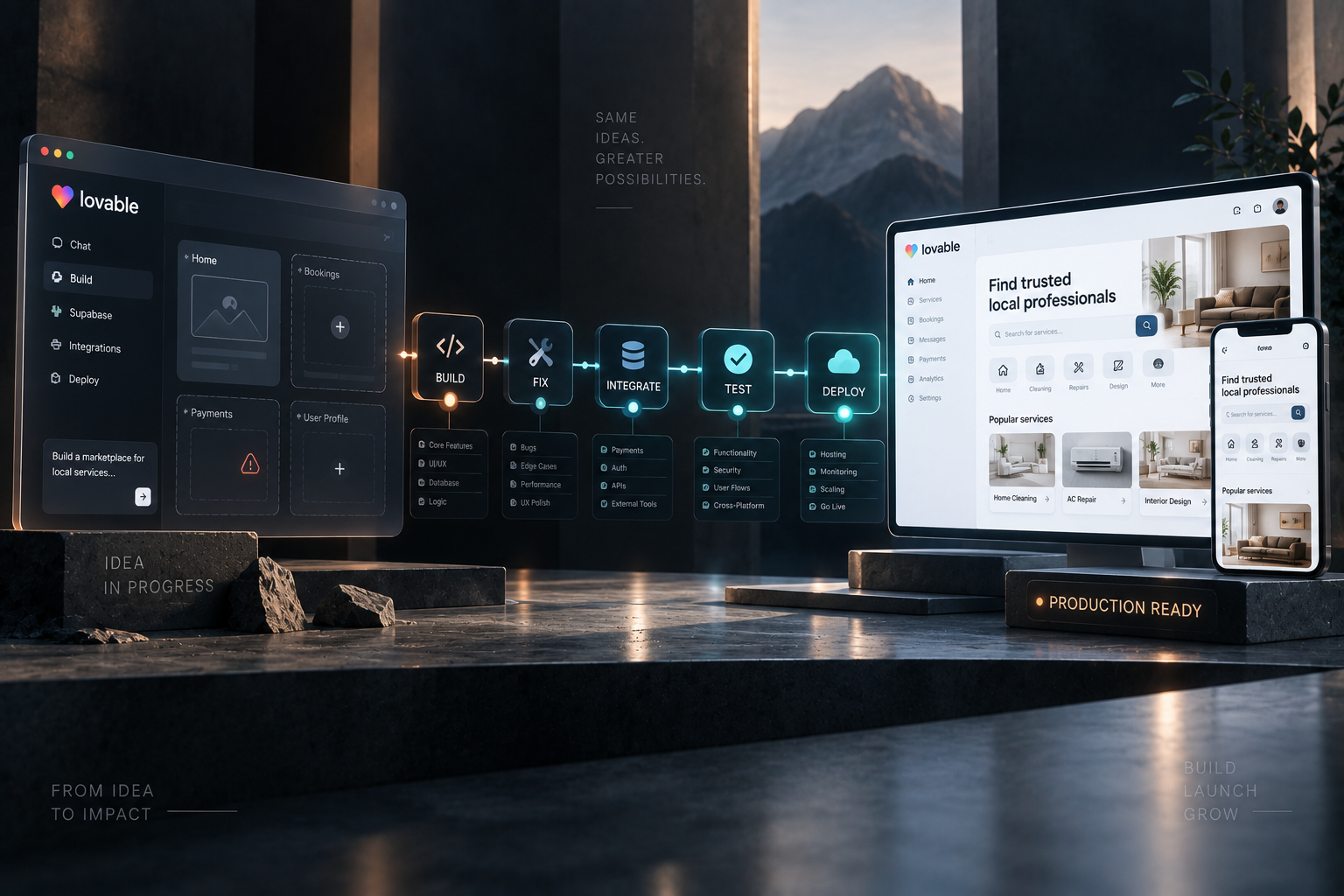
Most people hear MVP and think "bare minimum product I can possibly ship."
That mindset creates weak apps that nobody wants to use.
I prefer thinking about it differently:
Minimum Valuable Product
Not the absolute smallest thing you can technically build and push live, but the smallest thing someone would genuinely consider paying for.
Here's my rule: if a complete stranger can't open your app and experience clear value within 60 seconds, your MVP is already too complicated.
Speed without immediate usefulness is just noise polluting an already crowded market.
Keep that principle front and center for every single day of this process.
Before you open Lovable, before you touch any design interface, before you even think about features, stop.
Building without validation is just gambling with extra steps.
And look, in two decades of doing this work, I've seen more founders completely blow their budget and time here than anywhere else in the process.
Stop brainstorming "cool ideas" or things that would be "nice to have."
Start studying real complaints from real people.
Actual businesses are born from frustration and pain, not from inspiration or clever pivots.
Here's where to look:
• Reddit threads where people are actively ranting about something • Indie Hacker and Hacker News comment sections • SaaS review sites (especially the 1-3 star reviews) • Competitor app reviews on the App Store • Twitter/X threads where people are complaining • Founder Slack groups and Discord communities
You're looking for repeated pain. Not one-off complaints.
When you see the exact same frustration mentioned 20, 30, 50 times across different platforms and contexts, that's not random noise. That's actual market demand screaming at you.
Some examples of what this looks like:
"God I hate having to switch between five different tools just to create one invoice" "Manually tracking leads in spreadsheets is slowly killing me" "Why does customer onboarding take three hours when it should take five minutes"
Each of those sentences is a potential MVP sitting right there.
Your job isn't to invent something groundbreaking and original. Your job is to make something that already exists but simpler, faster, or less painful.
Write this down in one sentence:
[User type] → [Specific pain] → [Fast result]
If you can't explain what you're building in literally one sentence, it's too complicated and you need to simplify.
This is where most founders completely overbuild and waste days.
They start imagining dashboards, analytics panels, third-party integrations, settings pages with 47 toggles, user management systems.
All completely unnecessary at this stage.
Your MVP needs to deliver exactly one promise. One transformation.
Not some vague general promise like "manage your business better" or "increase productivity."
But something specific and concrete:
"Generate professional invoices in under 30 seconds" "Create a week of social media posts in one click" "Automate your entire client onboarding process instantly"
Specific, measurable wins convert users.
General fuzzy features just create confusion.
When you're working inside Lovable, your entire focus should be the shortest possible path between the problem and the outcome.
Anything and I mean literally anything that doesn't directly contribute to delivering that outcome gets cut.
No exceptions. No "but it would be nice to have." No "we might need this later."
Cut it.
Now you actually open Lovable.
But here's where discipline matters.
You're not building "an app" with all the trappings and features that implies.
You're building one specific journey from problem to solution.
That journey should look something like this:
Landing → Input → Action → Result → Signup/Payment
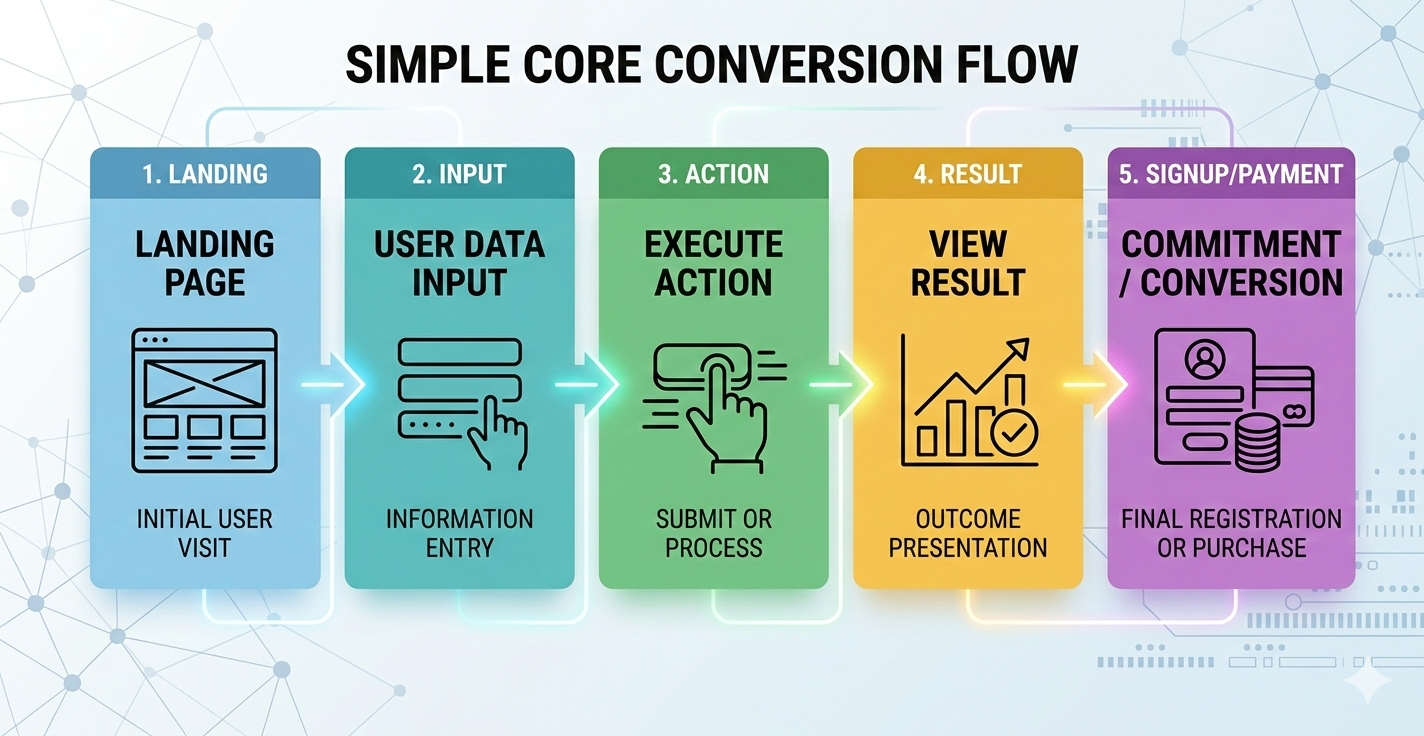
Five steps maximum. Ideally fewer.
That's the entire product for now.
What you're actively skipping:
• Fancy animations or transitions • Complex settings and configuration options
• Multiple dashboards showing different views • Admin panels and user management • Custom themes or appearance options • Profile pages • Social features • Notification systems
Your first 50 users genuinely do not care about any of that stuff. They care about whether your product actually solves their problem in the next two minutes.
This is where Lovable genuinely shines you can visually assemble these workflows incredibly fast without getting bogged down in engineering complexity or backend architecture decisions.
Focus purely on function. Making it work matters infinitely more than making it pretty.
Speed beats polish at this stage. Every single time.
This is where my background in SEO and conversion optimization heavily influences how I think about product building.
Getting traffic to your product means absolutely nothing if people don't take action when they arrive.
Every single screen in your MVP needs to clearly answer one question:
What should the user do next?
Use these principles:
• One clear, obvious call-to-action per screen • Simple, conversational language (not marketing jargon) • Short sentences that are easy to scan • Visible benefits stated plainly • Absolutely zero visual clutter
Avoid technical explanations at all costs.
Nobody buys "AI-powered workflow automation leveraging machine learning."
They buy "Save 5 hours every single week."
Humans respond to tangible outcomes, not to mechanisms or technology.
Your MVP's design should feel almost stupidly obvious. Boring, even.
Boring converts.
Clever and confusing kills growth and makes you feel smart while your product fails.
This is the step that almost every "build fast" guide completely ignores.
And it's why most of those approaches fail spectacularly.
If nobody knows you exist when you launch, your MVP doesn't matter. It doesn't matter how good it is, how well it works, how elegant the solution is.
As someone who's spent 20 years living inside search engines, analytics dashboards, and growth channels, let me be completely direct:
Traffic is oxygen for digital products.
Without it, your product suffocates slowly while you watch your savings account drain.
Things you should be doing before launch day:
• Create a dead simple landing page explaining the problem you solve • Set up a waitlist (even if it's just a Google Form) • Share your progress publicly on Twitter, LinkedIn, wherever your audience hangs out • Post in relevant communities without being spammy • Write problem-focused content that ranks in search • Actually talk to potential early users and get their emails
You want at least 50-100 people who are genuinely waiting for your launch.
Even 20 interested people who've given you their email is infinitely better than zero.
Products that launch into complete silence almost never recover. The momentum just isn't there.
Not surveys. Not feedback forms. Not "hey what do you think about this?"
Watch them use it. Live.
Schedule screen shares. Sit there in silence while they click around.
Observe without interrupting.
You'll learn more in 30 minutes of watching someone struggle through your product than you will in three weeks of reading survey responses or getting feedback from friends.
If they hesitate you have friction. If they ask questions you lack clarity in your UX. If they leave without completing the core action you completely failed to deliver the value you promised.
Fix only the absolute blockers that prevent people from experiencing value.
Ignore feature requests entirely for now.
Early users will ask you for everything. They'll want 47 different features, integrations with tools they use, customization options, advanced settings.
But they only truly need one thing to work exceptionally well.
Your entire job at this stage is finding what that one thing is and making it flawless.
This is where courage actually matters more than skill.
Perfection delays progress. It always has, it always will.
Launch is messy. Get it live even if you're slightly embarrassed by parts of it.
Then collect actual usage data instead of opinions.
Find the best agencies ranked by us: https://www.inceptmvp.com/blogs/best-lovable-development-agencies
Track these numbers religiously:
• Signups (how many people create accounts) • Activation (how many actually complete the core action) • Time to value (how long until they experience the benefit) • Drop-off points (where are people leaving) • First payments (if monetized, who's paying and why)
Numbers tell you the uncomfortable truth. Opinions tell you what people think you want to hear.
Then improve the product every single day based on what you're learning.
The real competitive advantage of tools like Lovable isn't just building fast—it's iterating instantly.
You can push updates in minutes, not weeks.
Use that power. Don't waste it by perfectionism.
For more guidance visit: https://docs.lovable.dev/introduction/welcome
Your MVP is not your final product.
It's not even really a product yet.
It's a test. A learning device. A conversation starter with the actual market.
If you treat it like it needs to be a masterpiece, you'll move slowly, overthink everything, and probably never launch.
If you treat it like a scrappy experiment that you can improve daily, you'll move fast, learn constantly, and actually build something people use.
In startups, speed of learning beats quality of first attempt.
Every single time, without exception.
Ship fast. Learn faster. Improve constantly.
That's the entire game.
But here is the hack to jump on the next step for scalability: https://www.inceptmvp.com/blogs/how-we-use-lovable-dev-to-build-smart-scalable-mvps---fast
The fastest way to build a Lovable MVP is to focus only on one clear problem, validate it before building, and design a single core workflow that takes users from input to result without distractions. Speed comes from clarity, not feature count.
Most MVPs fail because founders prioritize speed over clarity. They build too many features, skip problem validation, and launch without understanding user pain. Fast execution without direction leads to products nobody needs.
Before building, validate the problem by researching real user complaints on Reddit, reviews, forums, and communities. The goal is to find repeated pain points that signal real demand before writing any code or designing screens.
A Lovable MVP should solve one specific problem with one clear transformation. If a user cannot experience value within 60 seconds, the MVP is too complex and needs to be simplified.
Only include the core workflow: landing, input, processing, result, and optionally signup or payment. Avoid dashboards, settings, admin panels, and unnecessary UI elements that do not contribute to the main outcome.
Design should focus on action, not aesthetics. Each screen should guide users toward one clear next step. Branding, animations, and visual polish should come after validation, not during the initial build.
Without an audience, even a good MVP fails. Founders should build a waitlist, share progress publicly, and gather early users before launch to ensure initial traction and real feedback from day one.
The biggest mistake is ignoring real user behavior. Founders rely on opinions instead of watching users interact with the product. Real insights come from observing friction, confusion, and drop-offs during actual usage.
.avif)


.svg)
.svg)
.avif)



.avif)
