

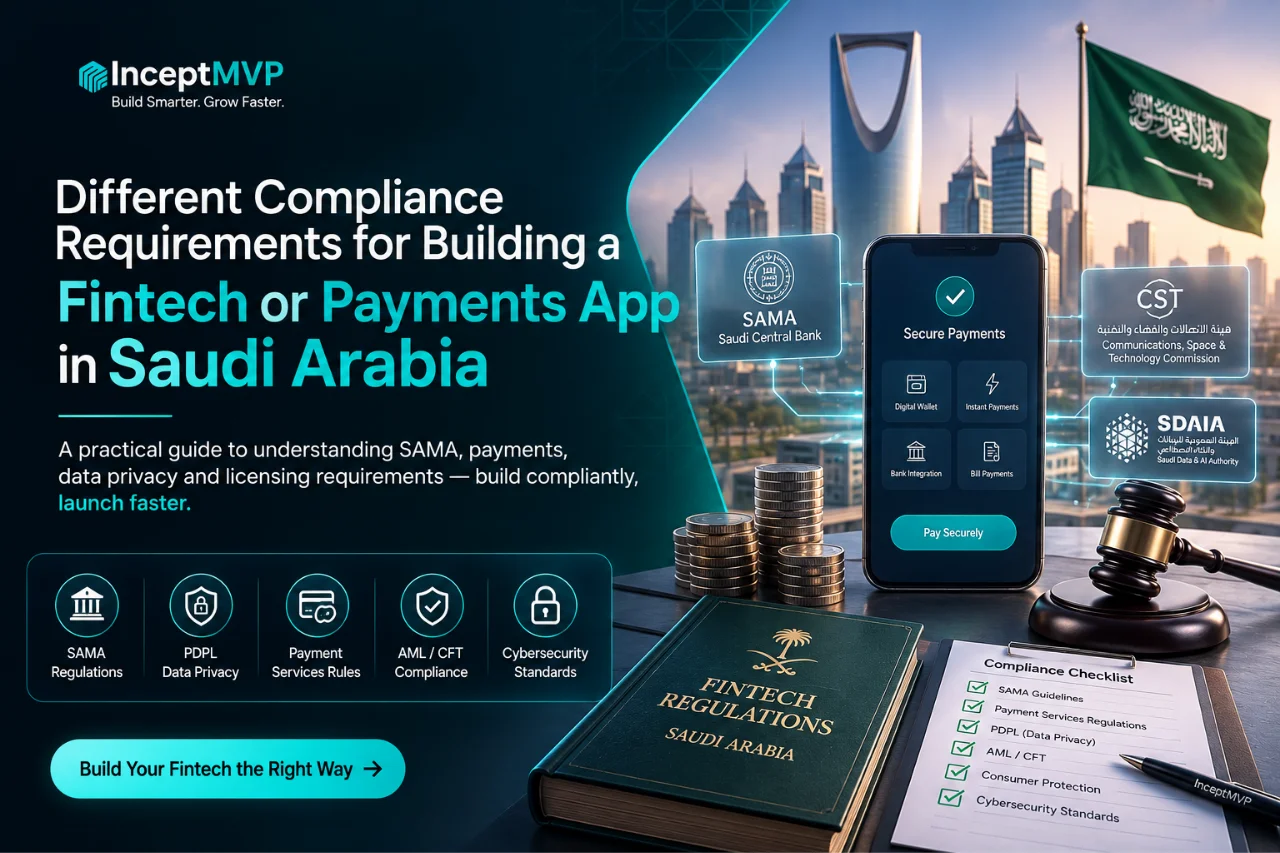
Building a fintech or payments application is very different from developing a regular mobile app.
A payment app handles some of the most sensitive information a user can provide, including:
Because of this, fintech companies must follow strict regulatory, security, and data protection requirements before launching their applications.
In Saudi Arabia, fintech and payment applications operate within a regulated environment designed to protect users, prevent fraud, and maintain trust in digital financial services.
This guide explains the major compliance requirements businesses should consider when building a fintech or payments app in Saudi Arabia.
A fintech application is not only a software product.
It is a financial service that must maintain:
Failure to meet compliance requirements can result in:
Compliance should be considered from the beginning of development, not added after the application is built.
The Saudi Central Bank (SAMA) plays a major role in regulating financial technology and payment services in Saudi Arabia.
Companies building fintech applications should understand whether their product falls under SAMA supervision.
This applies to applications involving:
Depending on the business model, companies may need:
Payment applications must follow requirements related to secure transaction processing.
Businesses should consider:
A payment app should clearly define:
Fintech applications collect large amounts of personal information.
Saudi Arabia’s Personal Data Protection Law (PDPL) requires businesses to properly handle and protect personal data.
A fintech app may process:
Businesses should implement:
Only collect information necessary for providing the service.
Users should understand how their information is collected and used.
Applications should include:
KYC processes help fintech companies verify customer identities and prevent illegal activities.
A fintech application may need identity verification features such as:
KYC helps prevent:
Payment and fintech companies must consider Anti-Money Laundering requirements.
AML systems help detect suspicious activities.
Common AML features include:
AI-powered monitoring systems are increasingly used to identify unusual transaction patterns.
Security is one of the most important parts of fintech application development.
A payment app should include:
Protect sensitive information during:
Examples include:
Users and employees should only access information required for their role.
Before launch, applications should undergo:
If an application handles card payments, PCI DSS compliance becomes an important requirement.
PCI DSS focuses on protecting cardholder information.
Key requirements include:
Many businesses reduce compliance complexity by integrating certified payment providers instead of directly storing card information.
Saudi Arabia has been developing its open banking ecosystem to encourage innovation in financial services.
Apps using banking data or financial APIs should consider:
Open banking allows fintech applications to create services such as:
Fintech applications often rely on cloud infrastructure.
Businesses should evaluate:
The infrastructure should support:
Payment apps require strong identity protection.
Common security features include:
Strong authentication reduces the risk of:
Payment platforms should continuously monitor transactions.
Fraud prevention systems can identify:
Modern fintech apps often use AI to improve fraud detection.
Businesses should clearly define ownership when working with a technology partner.
Contracts should specify:
This protects businesses when scaling or changing development partners.
Compliance requirements should influence architecture and development decisions from the beginning.
Businesses should avoid storing sensitive financial information unless required.
Fintech development requires knowledge of:
Security vulnerabilities discovered after launch can become expensive and damaging.
InceptMVP helps startups and businesses develop secure digital products, including fintech and payment-related applications.
The team supports businesses with:
The development approach focuses on building scalable applications while considering:
Yes. Depending on the type of financial service offered, fintech applications may require approval, licensing, or compliance with Saudi Central Bank requirements.
Payment apps may need to consider SAMA regulations, PDPL, AML requirements, cybersecurity standards, and PCI DSS requirements.
If the application handles cardholder data directly, PCI DSS compliance may be required. Many companies use certified payment providers to simplify compliance.
Important features include encryption, multi-factor authentication, secure APIs, transaction monitoring, fraud prevention, and security testing.
Yes. Many startups build fintech products, but they must ensure their applications follow applicable regulatory and security requirements.
The timeline depends on the complexity of the application, integrations, security requirements, regulatory needs, and testing process.



.svg)
.svg)
.avif)


.avif)
