

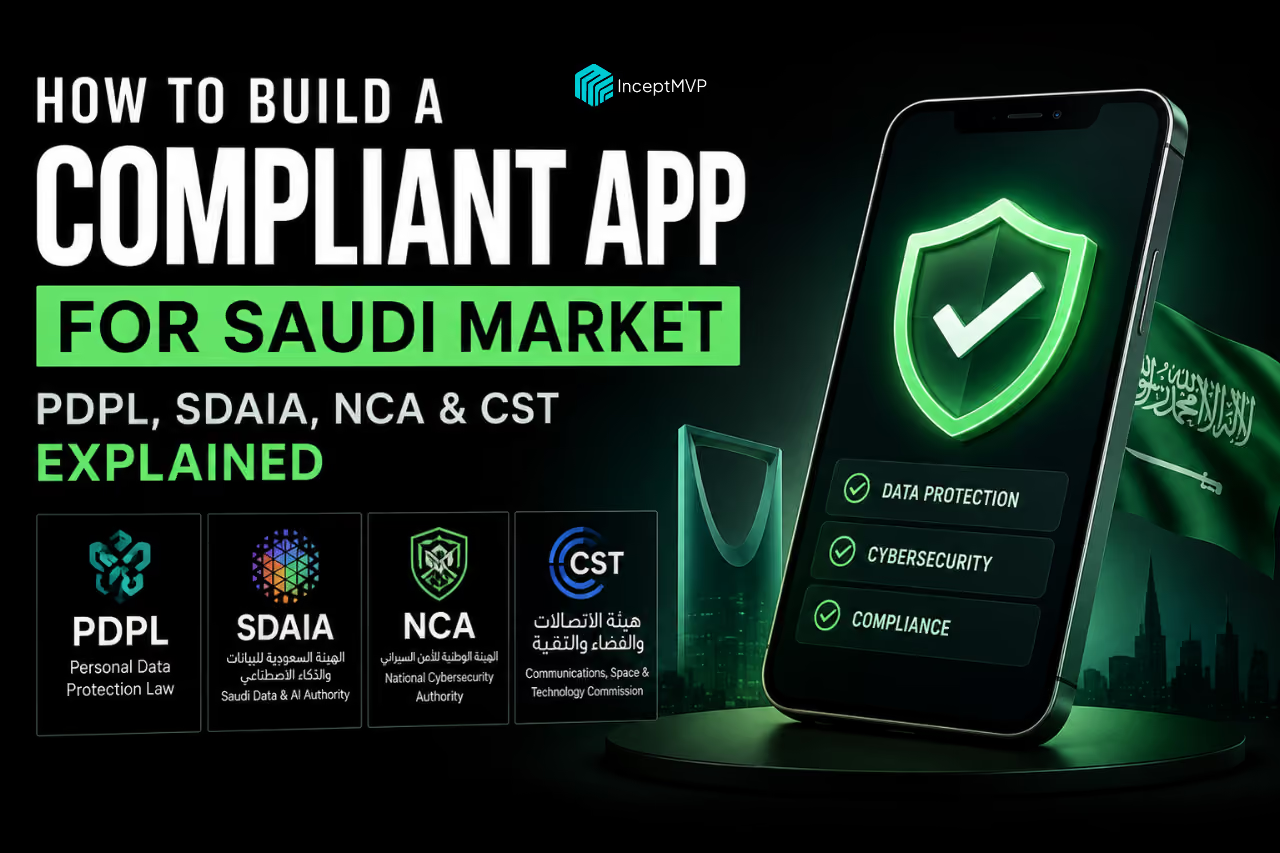
If you're building an app that will touch a single Saudi resident's data, "we'll deal with compliance later" is no longer a viable plan. Saudi Arabia's Personal Data Protection Law came into full force on 14 September 2023, and its compliance grace period expired on 14 September 2024. Since then, enforcement hasn't been theoretical. In 2025 and 2026, SDAIA's enforcement committees issued 48 decisions confirming PDPL violations, covering failures like processing data without a valid legal basis, unauthorized disclosure, missing technical safeguards, and unconsented marketing.
For founders building MVPs for the Gulf market, this changes the build process itself. Compliance now has to be part of the architecture, not a policy document you bolt on before launch.
Saudi Arabia doesn't have one single "app law." It has several regulators whose mandates overlap depending on what your app does.
SDAIA (Saudi Data and Artificial Intelligence Authority) is the body that enforces the PDPL. It's the competent authority responsible for supervising and enforcing the PDPL, and its mandate goes beyond privacy into national data governance and AI policy under Vision 2030.
NCA (National Cybersecurity Authority) issues the Essential Cybersecurity Controls (ECC), a mandatory security baseline. The ECC framework is built on four pillars, strategy, people, processes, and technology, organized into 114 controls across 5 domains, and aims to ensure confidentiality, integrity and availability of information assets while aligning with standards like ISO 27001 and NIST CSF. ECC applies to government organizations and to private-sector organizations that own, operate, or host Critical National Infrastructure, but its controls are widely treated as best-practice baseline even for private apps that want enterprise or government clients in KSA.
CST (Communications, Space & Technology Commission), formerly CITC, regulates telecom and wireless products. CST oversees products with wireless, radiofrequency, IoT, satellite, or telecom communication features and enforces type approval to verify compliance with local spectrum rules. This mostly hits hardware and connected devices, but it becomes relevant for apps offering VoIP calling, SIM-based verification, or IoT-linked features, where a local legal check is worth the hour it takes.
SAMA enters the picture only if your app touches payments, lending, or anything financial. If that's your use case, SAMA's Cybersecurity Framework runs alongside, not instead of, NCA ECC.
At its core, the PDPL defines "Personal Data" as any information, in any form, that could lead to the direct or indirect identification of a natural person, covering identifiers like names and national ID numbers, digital data like IP addresses and device identifiers, and sensitive categories like biometric identifiers, health status, financial account information, and data revealing religious or political affiliation.
It doesn't matter where your servers sit. The PDPL applies to all entities that process personal data within Saudi Arabia and applies extraterritorially to organizations outside the Kingdom that process the personal data of individuals located in Saudi Arabia, including international companies offering goods or services to Saudi residents without a physical presence in the country. If your no-code MVP is signing up Saudi users from anywhere in the world, PDPL applies to you.
Two operational details matter most for app builders:
The practical takeaway for a dev team: don't just copy your GDPR consent banner and privacy policy template. The data mapping, DPO/representative structure, and cross-border mechanism need a Saudi-specific pass.
Founders building on Bubble.io or FlutterFlow sometimes assume "no-code" means "no security responsibility." It doesn't. The compliance obligation sits with the controller, meaning you, regardless of what tool built the backend.
Practical checklist for a no-code MVP targeting Saudi users:
The PDPL is Saudi Arabia's comprehensive national data privacy framework, enacted under Royal Decree No. M/19, regulating how organizations collect, process, store, and transfer the personal data of individuals residing in the Kingdom, enforced by SDAIA.
They're similar in spirit but not identical. PDPL's cross-border transfer mechanism, fine structure, and testing-data rules are Saudi-specific and don't map one-to-one onto GDPR compliance work.
There's no single "app approval," but if you're a data controller processing Saudi residents' data, you fall under a national register of controllers, requiring registration with SDAIA.
Organizations face fines of up to SAR 5 million and potential criminal penalties for violations.
Only with a valid transfer mechanism and approval, cross-border transfer isn't automatic and needs to be confirmed per data flow, especially for global SaaS or cloud infrastructure hosted outside the Kingdom.
ECC formally applies to government entities and organizations owning or hosting Critical National Infrastructure, but many enterprise and government clients now expect ECC-aligned security practices from any vendor, so treating it as a baseline is smart even if you're not legally in scope yet.
The platforms don't handle compliance for you. Data location, encryption configuration, and access control need to be deliberately set up regardless of the build tool.





.svg)
.svg)


.avif)
