

.avif)
Every few months we hear the same story.
A founder built everything on Bubble in six weeks. It felt like a superpower. Fast, affordable, functional. Real users, real data, real payments. No developers needed.
Then comes the second part of the story.
Now they cannot scale. The app slows down under real traffic. A feature they need is not possible without fighting the platform. And the cost of migrating everything they built feels almost as daunting as starting from scratch.
This is not a story about Bubble being bad. It is a story about using the right tool for the right stage and knowing in advance where the road ends.
After working with enough early-stage founders to see this pattern repeat, here is an honest breakdown of what Bubble genuinely does well, where it starts showing cracks, and how to make the decision that fits where your product actually needs to go.
Bubble did not become one of the most widely used no-code platforms by accident. For a specific set of problems, it is genuinely excellent.
This is the core value proposition and it is real.
Most early-stage startups do not fail because the idea was bad. They fail because they spend four to six months building before finding out whether anyone wants what they are building. Bubble compresses that timeline dramatically.
You can build a working marketplace, a booking system, a CRM, an internal dashboard, or a membership platform in weeks rather than months. Not a mockup. An actual working product with real users interacting with real data.
For founders who need to validate demand, pitch to investors, or get something in front of users before a competitor does, that speed is meaningful leverage. You learn faster, iterate faster, and avoid spending serious money on features nobody asked for. [Internal link placeholder: How to Validate Your Startup Idea Before You Build It]
Bubble's drag-and-drop interface removes the technical barrier that stops a lot of smart, capable people from building their own products.
Designers, marketers, operators, and solo founders can build tools they would otherwise have needed a developer for. You design pages visually, connect workflows without writing backend logic, and ship updates the same day you make them.
This is particularly useful for pre-funding prototypes, internal tools, early experiments, and proof-of-concept builds before a technical hire makes sense. The ability to change things yourself without filing tickets or waiting on a sprint cycle gives small teams speed that would be difficult to match any other way.
Hiring developers before you have validated anything is expensive. Even a small team runs into serious monthly costs before a single user sees the product.
Bubble changes that math. A monthly subscription replaces payroll, infrastructure, and deployment costs. For bootstrapped founders or first-time entrepreneurs, that lower financial pressure creates room to test, fail, adjust, and test again without burning through a runway that was never that long to begin with.
You can validate a business idea before committing significant capital to building it properly. That is a genuinely useful risk reduction, especially in the earliest stages. [Internal link placeholder: How to Plan Your MVP Budget Realistically]
Hosting, servers, database management, deployments, security patches, and uptime monitoring are all handled inside Bubble's ecosystem.
For a small team focused on product and users, not having to think about infrastructure is a real advantage. You do not need a DevOps person. You do not need to configure cloud services. You just build and ship.
For many early-stage products with modest traffic expectations, this alone makes Bubble worth considering. The technical overhead disappears and the team stays focused on the things that actually move the business forward.
Most founders evaluate tools by asking what they can build. Fewer ask what happens when the product starts to grow. That is where the limitations become expensive.
As an app grows in complexity and user volume, Bubble apps slow down.
Database queries get heavier. Workflows become harder to optimize. Page load times increase in ways that are difficult to address within the platform's constraints.
This matters more than it sounds. Slow apps hurt SEO rankings, reduce conversion rates, and frustrate users in ways that are hard to recover from. A product that worked smoothly with fifty users can feel broken with five thousand. And the tools available inside Bubble to fix performance problems are limited compared to what custom development allows. [Internal link placeholder: How to Know If Your App Is Actually Validating]
Bubble is excellent for standard use cases. The moment your product needs something genuinely unconventional, complex permissions structures, deeply custom workflows, unusual data relationships, or non-standard integrations, you start working against the platform rather than with it.
Every workaround you build on top of a limitation creates technical debt that compounds. The product gets harder to maintain, harder to extend, and harder to hand off to a development team later. What felt like flexibility in week two becomes rigidity in month twelve.
This is the one that surprises founders most when they hit it.
When you build on Bubble, you do not own the infrastructure. You do not control the backend in any meaningful sense. If Bubble changes its pricing, deprecates a feature, or has a significant outage, your product is affected in ways you cannot control or quickly fix.
More practically, migrating a Bubble app to custom development is genuinely difficult. The data structures, workflows, and logic built inside Bubble do not translate cleanly to a traditional codebase. In most cases, migrating means rebuilding significant portions of the product rather than lifting and shifting what already exists.
That is a real cost in time, money, and momentum that founders rarely factor in when choosing the platform at the beginning.
For simple consumer apps, Bubble's built-in security is adequate.
For anything touching sensitive data, healthcare records, financial information, enterprise client requirements, or regulated industries, the platform's security controls are not sufficient.
Strict data residency requirements, advanced encryption, detailed audit logging, and compliance frameworks like HIPAA or SOC 2 are either unavailable or extremely difficult to implement properly inside Bubble. If your product is likely to move into any of these territories, the platform may not be able to grow with you. [Internal link placeholder: How to Choose the Right Development Agency]
The initial pricing feels very reasonable. But as usage grows, the cost picture changes.
Capacity upgrades, performance add-ons, plugin subscriptions, and higher tier plans add up in ways that can make Bubble more expensive at scale than founders anticipated. At a certain usage level, the economics of custom development start to look more attractive, not just technically but financially.
Being honest about limitations does not mean dismissing the platform. Bubble is genuinely the right choice in specific situations.
If you need to get something in front of users in weeks rather than months, Bubble is hard to beat. If you are building an internal tool for a small team, it is probably the most efficient option available. If you need a clickable, functional prototype for investor conversations before committing to a full build, Bubble does that job well. If your product has straightforward workflows, moderate traffic expectations, and does not need deep customization, it may serve you for longer than you expect.
The key is going in with clear eyes about where the ceiling is and having a plan for what happens when you approach it.
The founders who reach out to InceptMVP after a Bubble build tend to share a consistent profile.
The product is working. Users are there. But something is blocking the next stage. Performance is degrading under real load. A critical feature is not achievable within the platform. A potential enterprise client has security requirements that Bubble cannot meet. The cost of capacity upgrades is approaching what a proper build would cost anyway.
Custom development becomes the right move when you need genuine performance at scale, full ownership of the codebase and infrastructure, complex workflows that require real engineering, security standards beyond what no-code allows, deep API integrations with enterprise systems, or a technical foundation that will not need to be replaced again in eighteen months.
What InceptMVP builds is not overengineered. It is lean, properly architected, and designed to grow. Code the founders own. Infrastructure they control. Security built in from the start rather than bolted on when a problem surfaces. [Internal link placeholder: How to Turn a Startup Idea Into a Real Product]
Here is something most tool comparison articles skip.
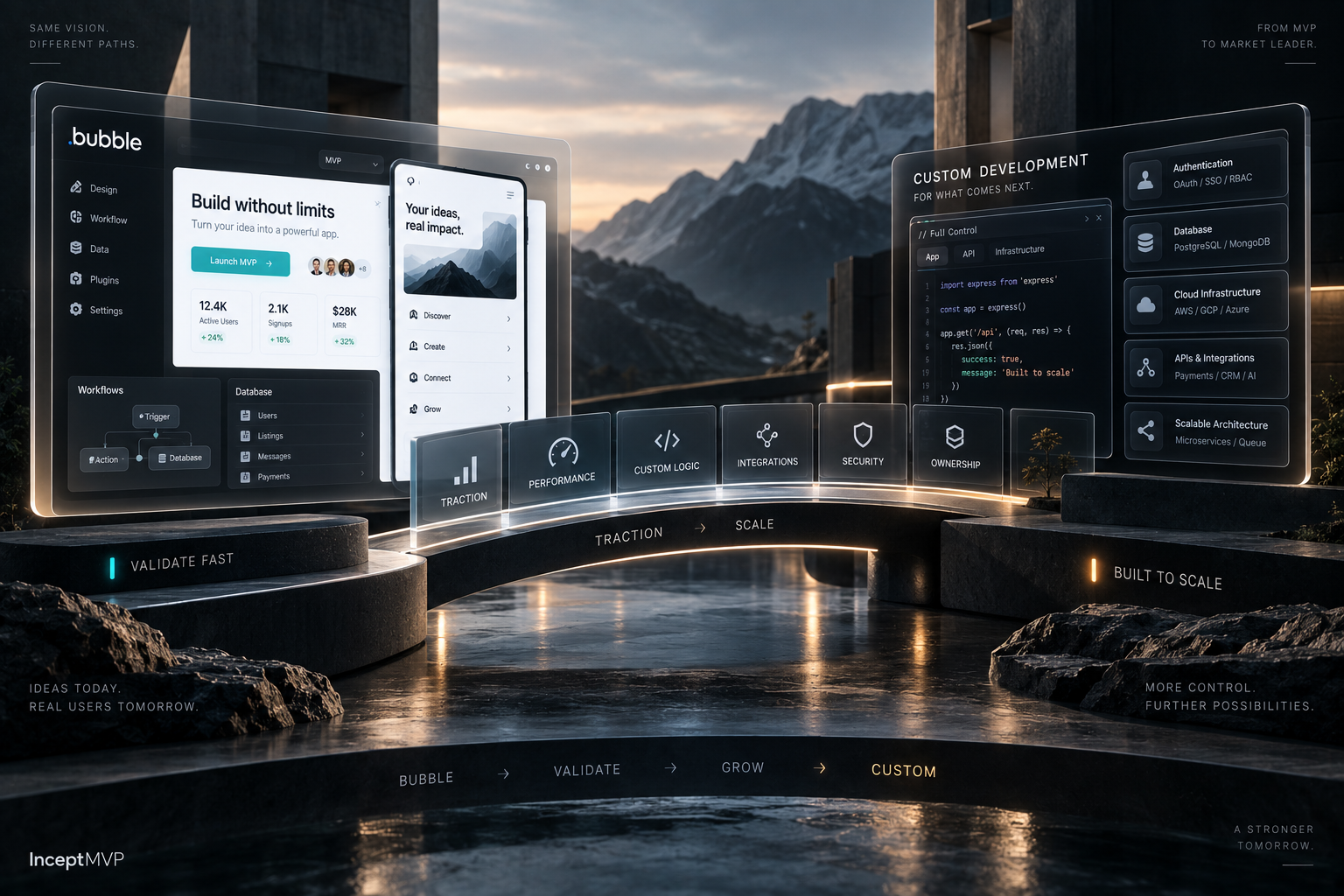
The choice is not always Bubble or custom. For a lot of startups, the smartest path is both, in sequence.
Validate fast with Bubble. Get real users. Prove the core concept works. Then, once you have traction and understand what the product actually needs to be, rebuild the critical parts on a custom foundation.
Think of Bubble as scaffolding. It is useful while you are figuring out the shape of the building. But scaffolding is not the building itself. Knowing the difference, and planning for the transition before it becomes urgent, is what separates founders who scale smoothly from the ones who end up rebuilding under pressure.
The time to think about that transition is not when you are already stuck. It is during the validation stage, while options are still open. [Internal link placeholder: Complete Guide to Launching an App]
Bubble is a strong starting line. It is not a finish line.
If you are testing an idea, Bubble gives you speed and efficiency that would be very hard to match any other way. If you are building something meant to grow significantly, support enterprise requirements, or handle complex workflows at scale, the transition to custom development becomes a question of when, not whether.
The mistake is not choosing Bubble. The mistake is assuming it will carry you the whole way without ever thinking about what comes next.
Build fast. Validate faster. But when growth starts demanding more than the platform can give, make sure you have a plan that does not require rebuilding everything under pressure.
If you are trying to figure out which path fits your product right now, that conversation is exactly what InceptMVP is built for. [Internal link placeholder: Work With Us]
Yes, for the right kind of MVP. Bubble is excellent for rapid prototypes, early validation, investor demos, and internal tools. It lets founders get a working product in front of real users in weeks rather than months, which is exactly what the early validation stage requires.
They can handle growth to a point, but performance and cost issues tend to appear at higher traffic and complexity levels. Database-heavy workflows and complex logic become increasingly difficult to optimize inside the platform as usage grows.
The right time is usually when performance is degrading under real load, when a critical feature cannot be built within the platform's constraints, when security or compliance requirements exceed what Bubble supports, or when the cost of capacity upgrades approaches what a proper custom build would cost.
For straightforward consumer apps, yes. For products handling sensitive data, operating in regulated industries, or serving enterprise clients with specific security requirements, custom development provides significantly better control and compliance capability.
Technically yes, but it almost always involves rebuilding significant portions of the product rather than a clean migration. The data structures and logic inside Bubble do not translate directly to a traditional codebase. Planning for this transition early, before it becomes urgent, makes it considerably less disruptive.


.svg)
.svg)
.avif)



.avif)
