

.avif)
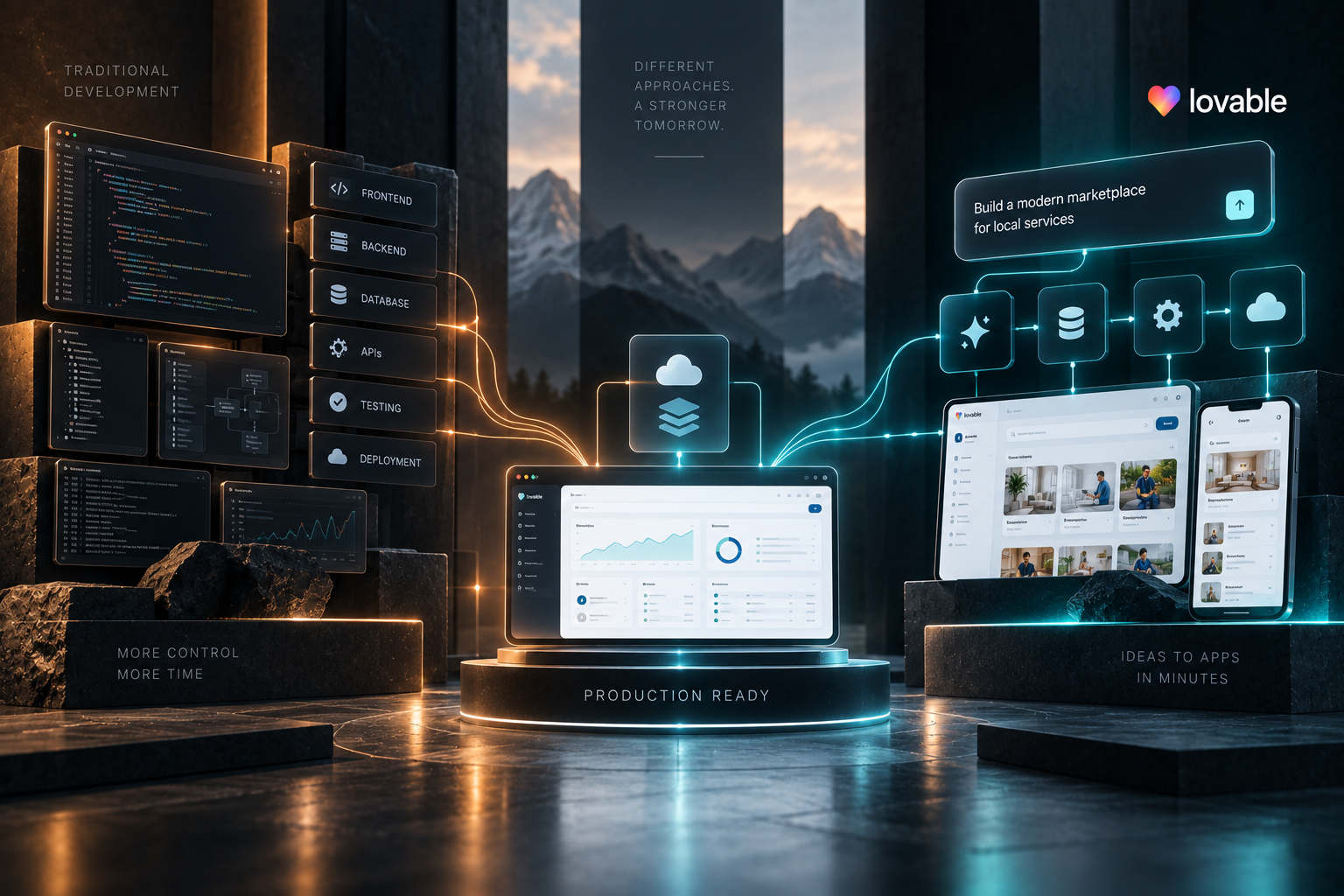
The barrier to building software has officially been smashed. We’re moving past code-heavy workflows into an age where platforms like Lovable can turn a single idea into a functioning, scalable application in days. This revolution means startups can now blend lightning-fast automation with genuine human innovation to build products smarter and faster than ever before.
For too long, the default mindset in tech was manual coding. That meant long hours spent writing, debugging, and deploying things line by agonizing line. But as the business world demands lightning-fast results and true flexibility, we’ve finally stepped into the exciting new era of AI-assisted development.
Why is 2025 the absolute tipping point? Because with the rise of AI-powered tools, low-code, and no-code platforms coupled with sophisticated artificial intelligence software development startups can achieve liftoff in record time. The role of the developer isn't to be a typist anymore; it's to be a brilliant orchestrator, focused on product vision and creativity while the AI handles the repetitive, complex grunt work. The game has changed, and the future of coding is here.
When we talk about traditional development, we mean building an app from the ground up using core programming languages like JavaScript, Python, or C ++. It’s powerful, allowing for unlimited customization and control over every pixel and function.
The major problem? It’s simply too slow and incredibly expensive. Every feature requires dedicated human hours for coding, review, and maintenance. If your team needs a highly complex, custom-coded website, you’re inherently signing up for higher costs and slower development cycles that can take weeks or even months just to get to a Minimum Viable Product (MVP).
Custom coding isn't dead—it's just reserved for specific use cases. If you are building a highly specialized, resource-intensive platform (like a bespoke financial trading system or a bleeding-edge graphics engine), that level of deep, manual control remains essential.
Enter Lovable AI. Think of it as the ultimate accelerator. It’s an intelligent platform that doesn't just assist with code; it handles the entire application generation process. Lovable translates natural language instructions into full-stack web applications, managing the front-end, back-end, and database connections instantly.
The magic of the Lovable app builder is speed. You provide the intent, and the AI platform generates the core scaffolding of the application. Need a user dashboard with database integration? That’s minutes, not weeks. This is the definition of building apps with AI 2025.
Whether you're a startup founder trying to validate an idea without hiring a huge team, an experienced developer looking to prototype ten times faster, or a non-coder trying to bring your vision to life, the Lovable website builder makes the process accessible to everyone.
This is where the difference between AI that helps you code and AI that builds for you becomes clear.
Both Lovable and Bolt promise instant deployment for startups, but they differ in scope and underlying technology. Lovable’s strength lies in its generative AI capability to create unique structures, offering a potentially stronger choice for end-to-end application creation, deployment, and later iteration. If you’re hunting for the best AI app builder 2025, the platform that offers the most robust path from zero to MVP wins by helping you build fast, deploy faster, and ultimately save time and costs.
When you look at the metrics, the case for AI-driven development becomes overwhelming:

Lovable’s instant generation crushes the weeks required for traditional builds. This shift offers lower maintenance and helps companies save time and costs, leading to much faster business growth with AI. AI is truly redefining what "quality" means, prioritizing functional, secure, and rapidly deployed products.
We have to be honest: AI-generated code isn’t always production-ready right out of the box.
Pure AI generation often hits walls when dealing with website scalability with AI at high traffic volumes, integrating niche third-party APIs, or requiring truly unique design flair. While AI can get you 80% of the way there, the last 20% the high-performance optimizations and custom logic still requires human engineering.
The key isn't AI or humans; it’s AI and humans. The real future of artificial intelligence software development is a hybrid AI development model where developers audit, refine, and deploy the AI-generated code.
The smartest companies today those focused on the future of coding are adopting a unique model. They use tools like Lovable for the foundational speed and then bring in expert developers to handle the high-end customization and performance audits. This is the hybrid AI development approach: AI-speed development with human precision.
This is the ultimate competitive blueprint for 2025: use the Lovable app builder to instantly generate the MVP, and then partner with experts to refine the code, ensure enterprise-level security, and guarantee website scalability with AI. That combination of apps with AI 2025 paired with human oversight is how ideas go from concept to market-ready success story.
Artificial intelligence software development won’t replace developers; it will radically empower them. Lovable leads this new wave of intelligent development, giving everyone the power to build. But true success in the coming years will lie in the balance: knowing when to let automation handle the grunt work and when to inject human insight and engineering expertise. The future belongs to those who build faster, smarter, and with purpose.
Lovable AI is an AI-powered app builder that converts natural language prompts into full-stack web applications. It automatically generates frontend, backend, and database structures, allowing users to build functional apps in minutes instead of weeks.
Traditional development requires manual coding, testing, and deployment, which takes significant time and resources. Lovable uses AI to automate most of this process, drastically reducing development time while still enabling functional MVP creation.
Lovable and no-code platforms like Bubble serve similar purposes but differ in execution. Bubble requires manual setup using visual workflows, while Lovable automates the entire build process using AI, making it faster for initial development.
No, AI tools do not replace developers. They enhance productivity by handling repetitive tasks. Human developers are still essential for scalability, performance optimization, security, and complex customizations.
Traditional development is better suited for highly complex, performance-intensive, or compliance-heavy applications such as fintech platforms, enterprise systems, or large-scale SaaS products.
Yes, Lovable is ideal for MVP development. It allows startups to quickly validate ideas, test user demand, and iterate without heavy upfront investment in engineering.
AI-generated apps may face challenges in scalability, advanced integrations, custom logic, and performance under heavy traffic. They often require human refinement before becoming production-ready.
The hybrid approach combines AI-generated development with human expertise. AI handles rapid prototyping, while developers refine, optimize, and scale the product for real-world use.
Cursor enhances coding productivity for developers, and Replit focuses on collaborative coding environments. Lovable, however, focuses on generating complete applications, making it more suitable for rapid MVP creation.
AI will continue to accelerate development workflows, but the future lies in collaboration between AI tools and human developers. This combination enables faster, smarter, and more scalable product development.




.svg)
.svg)


.avif)
